

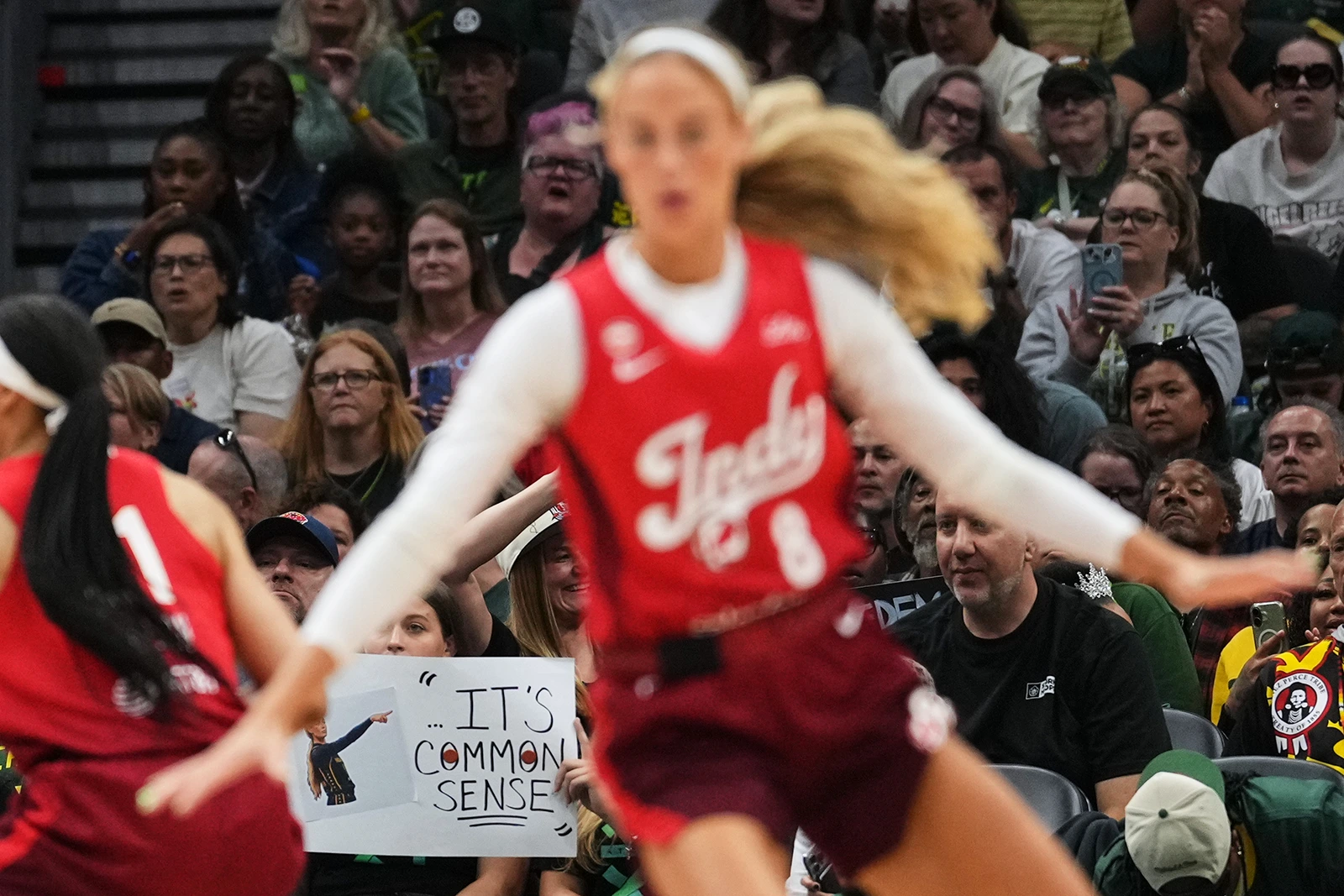
Indiana Fever guard Sophie Cunningham has been unapologetically blunt in her belief that transgender girls and women have zero place competing with cisgender females. That view on its face is one that is shared by a majority of Americans. But there are those looking to legitimately protect the safety of girls and women in sports and those looking to use the issue to demonize the transgender community as a whole — and Cunningham’s actions, more than her words, appear to put her far closer to the latter.
Cunningham claims to love everybody, insists she isn’t anti-trans and says her comments are about protecting women. But in choosing to pose for postgame photos on Sunday with outspoken trans critic Riley Gaines — the former swimmer who was one of the first people to speak out on trans women competing in sports with cisgender women — one could easily wonder if Cunningham is telling us a different story with the company she chooses to keep.
Why would a person in Cunningham’s position, with her platform and claims of loving everybody, choose to embrace Gaines?
Gaines gained notoriety after finishing in a fifth-place tie with trans swimmer Lia Thomas during an NCAA swimming competition in March 2022. Because organizers only had one fifth-place trophy and opted to give that to Thomas, Gaines had to receive her trophy at a later date. Using this dubious “I was victimized by a trans woman” narrative, Gaines operates under the guise of protecting girls and women in sports. But her rhetoric about the trans community at large shows a disdain that goes beyond the pale. From calling a Minnesota high school softball champion a boy to demeaning an eighth grade track-and-field athlete, Gaines has shown that her loathing of the trans community knows no bounds.
So why would a person in Cunningham’s position, with her platform and claims of loving everybody, choose to embrace Gaines?

To be clear, taking a photograph with someone doesn’t mean you endorse every word that person has ever uttered. Nor does calling someone a friend make you responsible for everything they’ve done.
The problem for Cunningham, however, is that she’s chosen to make character and compassion central to her defense. She tells us that her position comes from a place of love. Once you make that argument, the people you publicly embrace — and the behavior you’re willing to overlook — become relevant to whether that explanation holds up.
Cunningham speaks of protecting women. But does that mean “protecting cisgender women from transgender women”? What about protecting an eighth grade trans girl from a grown woman intent on humiliating her on national television by misgendering her? And if Cunningham wanted to be perceived as loving everyone, but also trying to protect girls and women in sports, wouldn’t she consider sitting down with the trans community to understand their perspective on such an explosive issue?

This is why Cunningham’s choices, beyond her words, matter to such a large degree.
I can’t speak to what is in Sophie Cunningham’s heart. None of us can. I really want to believe her when she professes to love everyone. But claims of love aren’t all that meaningful if they’re only extended to those whose humanity is easy for you to grasp.
The post Sophie Cunningham’s actions speak far louder than her words appeared first on MS NOW.

