President Donald Trump started the war with Iran with a promise to help free its people from an oppressive regime. Nearly five months later, U.S. forces appear to be bombing the civilian infrastructure those same people depend on.
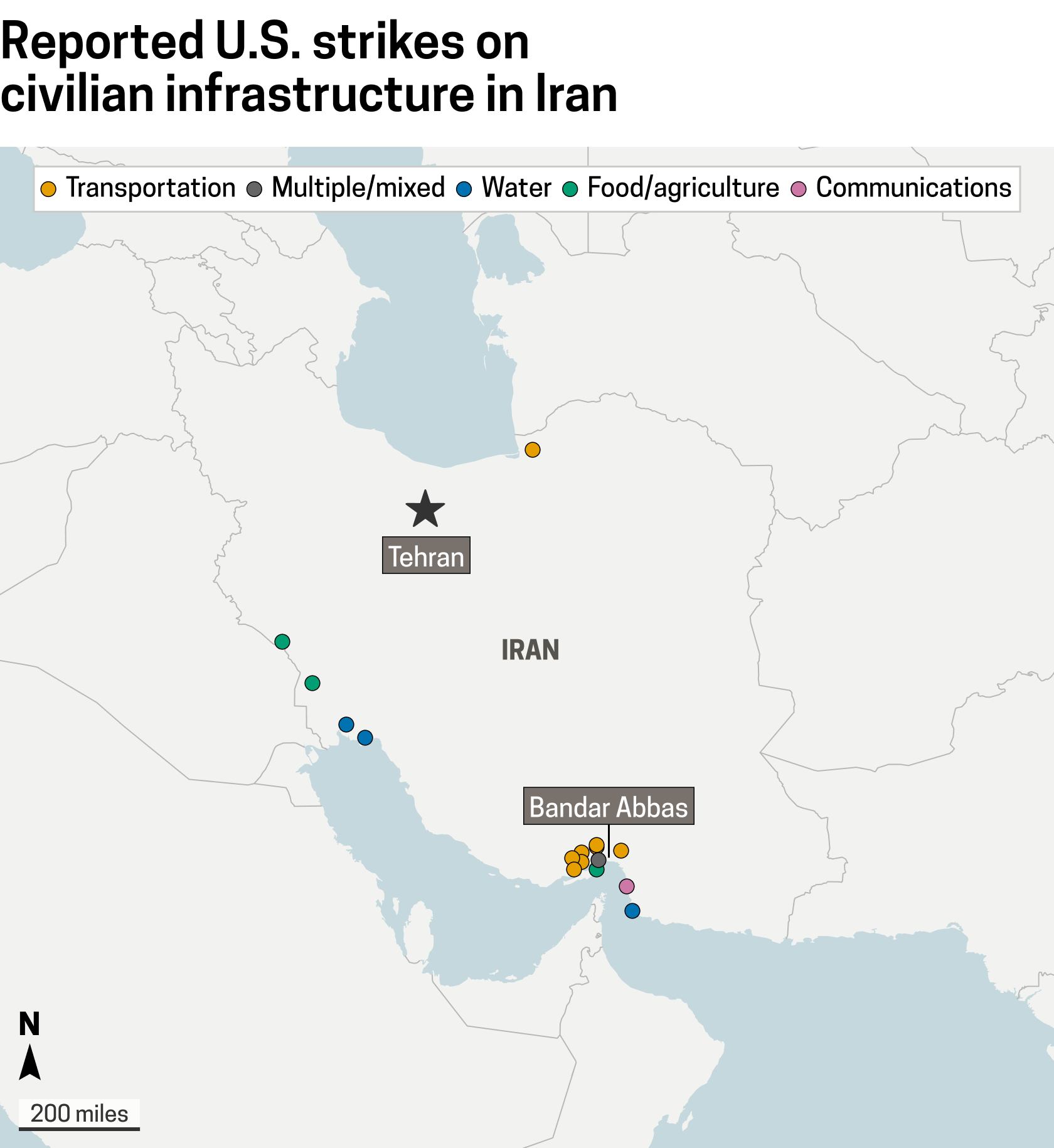
At least 21 strikes hit or damaged civilian infrastructure across Iran in July — including bridges, railways, telecommunication sites and water facilities — according to data compiled by Armed Conflict Location & Event Data, an independent conflict monitor, and shared with MS NOW. Each incident was documented by news agencies and human rights activists, including state-linked media outlets. Three water infrastructure sites were struck, including at least one desalination plant that supplies drinking water to thousands. Most of the destruction has occurred in southern Iran.

Map: Carson Elm-Picard / MS NOW; Source: Armed Conflict Location & Event Data; OpenStreetMap contributors
Zahriyannah Mohammadi Karakashian-Jones, an Iranian American, said her relatives in Bandar Abbas — a southern commercial and military hub by the Strait of Hormuz — can no longer evacuate their neighborhood if necessary by road after multiple strikes on nearby roads and bridges. She communicates with her family through messaging apps, but has not been able to reach them in the past four days.
“There’s essentially no evacuation route any longer,” she told MS NOW. “It makes me embarrassed to be an American. It makes me angry, especially when you consider that these acts of war are being carried out using my tax dollars.”
On Wednesday, Trump threatened to expand infrastructure attacks to Tehran.
“From this point forward, any time the Islamic Republic of Iran shoots at a ship in the Strait of Hormuz, whether it be by Missile, Rocket, Drone, or any other device or weapon, the United States will bomb and destroy ONE BRIDGE OR POWER PLANT, including those located next to, or in, the Capital City of Tehran,” he wrote on Truth Social.
Deliberate military action against civilian infrastructure is considered a war crime under international law. A U.S. official, who spoke on condition of anonymity to discuss military operations, denied that America’s military has intentionally targeted such sites.
“We are only hitting sites that have military capabilities, so no we are not committing any war crimes,” the official told MS NOW.
Administration officials have defended the strikes by arguing that some structures have dual uses for both civilian and military purposes. The Geneva Conventions permit attacks on such “dual-use” sites only when they offer a “definite military advantage.” Iran has also hit civilian infrastructure in Gulf countries in counterstrikes, including residential buildings and a drinking-water plant in Kuwait last week.
Iranian state media, citing local officials, accused the U.S. of cutting off drinking water to 10,000 people across 20 villages in the Hormozgan province. General Dan Caine, chairman of the Joint Chiefs of Staff, in a Senate hearing on Tuesday said he was not aware of water desalination plants “being particular targets,” or reports that desalination plants had been attacked.
“We have a robust process which considers a target — that goes through a system that looks at a variety of considerations, to include what you’re alluding to, around both purely civilian or dual-use targets,” Caine said, adding that he has “trust and confidence” in Central Command’s assessments. “I’ve got a lot of lawyers.”
When asked whether the U.S. was responsible for strikes on bridges, electrical infrastructure or water facilities, the White House did not comment. The Pentagon referred to U.S. Central Command, which has directly disputed at least one attack in the strikes compiled by Armed Conflict Location & Event Data: the reported bombing of a wheat storage facility in Hoveyzeh.

Note: Reported events recorded July 9 – 18, 2026. Locations may be approximate.
Map: Carson Elm-Picard / MS NOW; Source: Armed Conflict Location & Event Data; OpenStreetMap contributors
Trump’s threat Wednesday is the latest in a monthslong pattern. In March, Trump warned that the U.S. would target electrical plants, bridges and desalination plants in Iran before agreeing to a temporary ceasefire, which both sides have now abandoned. In April, he threatened that “a whole civilization will die tonight” and that he would blast Iran “back to the Stone Ages.” In mid-May, Trump said there “won’t be anything left” if Iran does not agree to U.S. terms to end the war.
In his initial address after strikes on Feb. 28, Trump told the Iranian people that “America is backing you with overwhelming strength and devastating force. Now is the time to seize control of your destiny and to unleash the prosperous and glorious future that is close within your reach.”
But experts say the level of destruction faced by civilians in Iran as a result of U.S. strikes has undercut that goal. More than 3,600 Iranians — at least 1,700 of them civilians — were killed in the first several weeks of the war, according to Human Rights Activists in Iran, including at least 300 children.
“They’ve dehumanized Iran and Iranians almost every step of the way that they’ve been in office,” said Ryan Costello, policy director at the National Iranian American Council. “Any claims that they’d be acting within the best interests of Iranians would be disingenuous at best.”
On the first day of the war, a strike on a girls’ school killed dozens of children and faculty members, and an early assessment concluded that the U.S. was likely responsible, MS NOW previously reported. Trump has told reporters that the internal investigation is ongoing.
“The fact that that happened on the first day, not on the 30th — in which, statistically, some mistake at some point was going to happen — it happened on the first day. That I think is something that already at that time left a terrible legacy,” said Trita Parsi, executive vice president at the Quincy Institute for Responsible Statecraft. “Both sides have done terrible things to each other, but seldom has so much negative been done in such a short period of time and so unnecessarily.”
Alex Vatanka, a senior fellow at the Middle East Institute, told MS NOW there was a major drop in Iranians’ support for U.S. military action as soon as civilian casualties began and it became apparent that there was “no American clear vision for post-Islamic Republic Iran.”
He expressed doubt that strikes on critical infrastructure would force Iran back to the negotiating table.
“What President Trump has misunderstood is this regime’s willingness to absorb a lot of pain,” Vatanka said. “They feel time is on their side, and that if they continue just responding to any American attacks, that eventually President Trump is going to stop risking escalation to a point of no return, and go back to the diplomatic track.”
Priya Sridhar contributed to this article.
The post ‘Dehumanized’: Toll mounts in Iran war with strikes on civilian infrastructure appeared first on MS NOW.