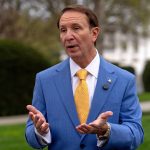
This is an adapted excerpt from the April 29 episode of “All In with Chris Hayes.”
Donald Trump’s war on Iran turns two months old this week. That means he is required by law to seek authorization from Congress by Friday to continue the war.
But more than 60 days into this conflict, Trump is not seeking a war declaration. He also is not ending it. Instead, he is in a quagmire of his own making that’s threatening the global economy and your bank account.
However, Republicans in Congress don’t seem to care. They have sidestepped their duty to check the president at every opportunity.
Instead of answers and accountability, instead of a strategy out of this mess, all the administration has is manufactured outrage.
That was on full display Wednesday, when the House Armed Services Committee met to discuss the Pentagon’s enormous, unprecedented budget request for next year. During that hearing, one of the biggest architects of this war, Secretary of Defense Pete Hegseth, tried to avoid talking about it.
Seven minutes into a nine-minute opening statement, Hegseth finally mentioned the war he helped start.
“This is a fiscally responsible budget. This is a warfighting budget,” the secretary told Congress. And speaking of warfighting, a topic, the topic of Iran, I’m sure, will come up today, which I very much welcome discussing.”
“Speaking of warfighting.” Nice segue. But I think it’s safe to assume the war might come up in a hearing with the guy who’s calling himself the “secretary of war.”
For more than five hours, it was mostly Democratic lawmakers who tried to pin Hegseth and his deputies down as to what is happening in the Middle East and inside the Defense Department, and the secretary acted like a truculent young teen with tanks and ships.
Instead of answers and accountability, instead of a strategy to get out of this mess, all the administration has is manufactured outrage. And when it does offer details, it is tough to know if it is telling the truth.
During the hearing, Jules Hurst III — the Pentagon’s acting comptroller and former aide to House Speaker Mike Johnson — finally put a price tag on the fighting. Hurst told Congress the ongoing war has cost the U.S. $25 billion so far.
That figure sort of beggars belief, considering the Pentagon told Congress in March that the first six days of the war alone cost taxpayers more than $11 billion. But now the Pentagon is saying that weeks two through nine combined cost just a little bit more than that?
Are we bombing less than at the beginning of the war? Yes. But we still have more than 50,000 troops and a dozen ships in the Middle East in a two-month-old war.
The Pentagon’s estimate also doesn’t take into account the higher costs of the conflict. When Iran responded to U.S. bombing by shutting down the Strait of Hormuz, it cut off more than just a fifth of the world’s oil supply.
Most Americans are already well aware of the energy shocks that have occurred, with the rising costs of gas and diesel fuel at the pump. On Wednesday, Brent crude oil jumped another 6% to $118 a barrel.
Batteries, fertilizer and pharmaceuticals also all depend on safe passage through the strait. The conflict has also affected aluminum supply, helium for balloons and medical applications like MRIs. And mortgage rates are rising because nobody trusts U.S. bond markets right now.
When it does offer details, it is tough to know if it is telling the truth.
But the truth is that we haven’t even felt most of the shocks yet. However, the administration says even discussing those shocks is loser talk.
When Rep. Ro Khanna tried to ask Hegseth if he knew how much the war would cost the average American over the next year, in terms of increased costs in gas and food, the secretary responded, “I would simply ask you what the cost is of an Iranian nuclear bomb,” and accused the California Democrat of asking “gotcha questions about domestic things.”
It’s clear this administration cannot account for the war’s growing costs. And to the extent that Trump and Hegseth do have a plan to end this conflict, it seems to amount to pulling an Uno “reverse” card on the Iranian blockade. During the hearing, the secretary bragged about the U.S. blockade. The president called it “genius” at an event in the Oval Office.
In a word, Trump and his officials are incompetent.
And this is apparently the incompetent war regime solution: Just let the blockade, the war and the global energy crisis it caused go on indefinitely and yell at anyone who asks hard questions about it.
Allison Detzel contributed.
The post There’s one word to describe Trump and Hegseth’s approach to the Iran war: incompetence appeared first on MS NOW.