Earlier this month, an investigative journalist revealed that buried in a trove of hacked documents from Madison Square Garden, there was a three-page dossier about … me.
It was in a folder titled “Facial Recognition Activists,” and time-stamped screenshots made it clear that someone had been keeping close tabs on me.
As a public-facing activist, this isn’t my first time being targeted by powerful people I’m trying to hold to account. But the incident should raise alarm bells, even for those who don’t spend their days tussling with CEOs and lobbyists.
Madison Square Garden’s surveillance capabilities rival those of some small countries — but there are far fewer rules governing how they can be used.
In recent weeks, several outlets have reported on Madison Square Garden owner James Dolan’s unapologetic use of high-tech surveillance, including a detailed report from Wired that his company uses the technology to track critics who visit the venue, monitor activists and celebrities, and in some cases ban attorneys from firms who have sued him or his organizations.
Seemingly undeterred by a lawsuit filed by Madison Square Garden over an earlier report that said MSG used technology to track LGBTQ+ celebrities. (The venue alleges that the outlet published “false and defamatory statements and implications”; Katie Drummond, the magazine’s global editorial director, has called the lawsuit “baseless and ridiculous.”) Wired this week published a piece reporting that MSG temporarily turned off its controversial facial recognition system during the star-studded wedding of Taylor Swift over the Fourth of July weekend. Swift did not comment on the report. When contacted for comment, a representative from Madison Square Garden said the venue is unable to comment on the story while it’s in litigation with Wired.
Ironically, Swift herself has reportedly used facial recognition at her own concerts to identify stalkers. This “privacy for me, surveillance for thee” attitude feels like a perfect encapsulation of the future we’re already living in: one where wealthy elites can afford privacy, while the rest of us are forced to live in a corporate surveillance panopticon.
Dolan and spokespeople for Madison Square Garden have defended their use of facial recognition as a necessary security measure to protect the patrons, and particularly the VIPs, that frequent Knicks games and concerts at the venue. But it’s hard to imagine a higher security event than Swift’s A-list wedding. The New York Police Department shut down streets as a precaution. The mismatch calls Dolan’s rationale for surveillance into question. It should also galvanize policymakers to focus on the private use of powerful AI surveillance tools.
Public discussion around facial recognition and other surveillance tech has largely focused on its use by government and law enforcement. But the spy-tech subplot in Swift’s love story reminds us that artificial intelligence has radically and rapidly rewritten the rules of privacy. It enables companies, and even individuals, to deploy surveillance at a scale previously only possible for highly developed nation-states.

In the United States, the Fourth Amendment places at least some limits on government intrusions into our privacy. Corporations and private individuals are under no such obligations. They don’t need probable cause to follow you around in public spaces with AI-powered cameras. They don’t need reasonable suspicion that a crime has been committed to put you in a database or on a watch list. In most places, they don’t need to inform you or ask for permission before they collect your intimate data, like a biometric scan of your face. Madison Square Garden’s surveillance capabilities rival those of some small countries — but there are far fewer rules governing how they can be used. No one elected Dolan. And he can’t be voted out.
Before you say “but I have nothing to hide,” listen up, law-abiding citizens! You don’t have to be personally targeted by surveillance for it to deeply affect your daily life, or darken the world your kids will grow up in.
Corporate surveillance means higher prices online and at the store when retailers can leverage data they have about your shopping habits to squeeze you for a few extra pennies. This seems distant from getting your face scanned walking into a concert hall, but the underlying technologies are similar.
Corporate surveillance means weaker environmental, food-safety and labor standards when companies can use their intelligence-gathering operations or stymie the efforts of advocates, journalists and researchers. For example, Reuters uncovered a hacking operation targeting environmental activists. And tech giants like Amazon have been accused of “algorithmic union busting,” leveraging their surveillance capabilities to prevent workers from organizing for better wages and conditions, which Amazon denies.
AI surveillance in the hands of wealthy individuals could create opportunities for Epstein-like abusers to get away with their crimes, allowing monied interests to get dirt on politicians, law enforcement and even judges.
While Dolan has made headlines for his aggressive use of surveillance technology reportedly to target those he has bad blood with, he’s not alone. And it’s not just social media companies spying on us to serve ads.
Uber announced it was investigating one of its executives for allegedly using the ride-hailing app to track a critical journalist using an internal company feature called “God View.” Amazon has leveraged its high-tech monitoring tools to squeeze more productivity out of its warehouse workers and delivery drivers. An anti-abortion group used cellphone location data — purchased legally from unregulated data brokers — to target social media ads at people who visited Planned Parenthood clinics. And an attorney for convicted sex offender Harvey Weinstein who was a longtime friend of Dolan’s reportedly hired private investigators to monitor and try to silence women who spoke up about abuse.
You don’t have to be personally targeted by surveillance for it to deeply affect your daily life, or darken the world your kids will grow up in.
Tech executives like Peter Thiel and Sam Altman openly fantasize about a hyperprivatized future with elites nestled in bunkers on private islands, guarded by surveillance tech, robots and drones.
Across corporate America, even mundane or seemingly justifiable uses of surveillance can have profound implications for our rights and safety. Macy’s is facing a lawsuit after its facial recognition system, purportedly used to catch shoplifters, was involved in a false arrest that put an innocent man behind bars. He was violently assaulted in jail before police discovered the mixup. This could happen to anyone.
AI surveillance tech may be new. But elites’ self-motivated desire to spy on workers, critics, politicians and competitors isn’t.
The robber barons of the 19th and 20th centuries protected their power and wealth by amassing private armies of spies, spin doctors and henchmen. The Pinkerton Detective Agency — which still conducts surveillance for Amazon and other large companies, albeit under a new name — deployed hundreds of spies to infiltrate labor unions and break strikes with a combination of COINTELPRO-style misinformation and brutal violence. Today’s oligarchs can accomplish the same with much greater efficiency using AI, data brokers and hacking software instead of guys in trenchcoats and fedoras.
Corporate surveillance may be threatening to eat our democracy. But it hasn’t swallowed it yet. We have a narrow window of time to enact laws that restrict private surveillance before we lose the democratic norms and institutions necessary to do so.
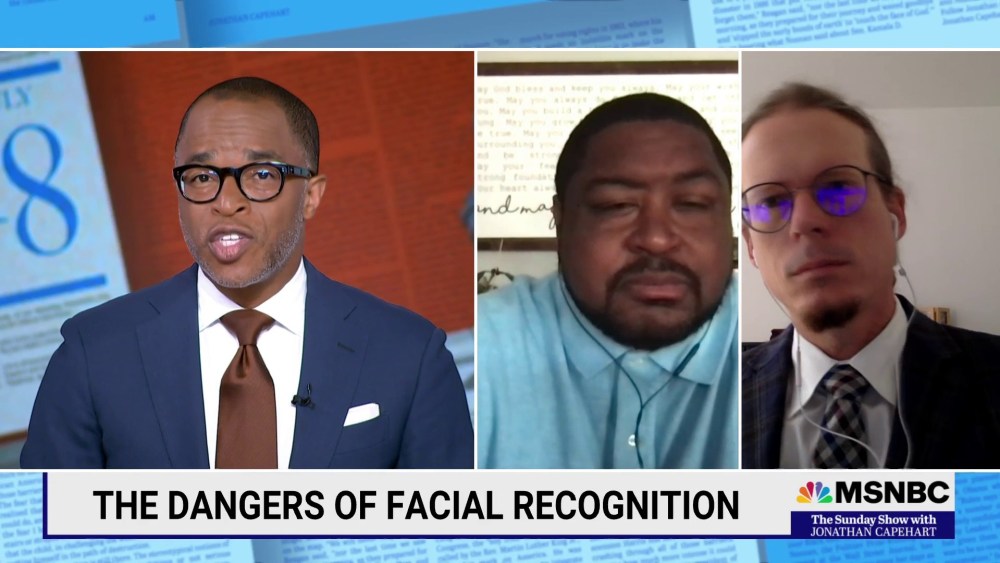
Here’s the good news: While Taylor Swift’s music may be popular, her wedding venue’s use of facial recognition is anything but. Madison Square Garden, Radio City Music Hall, and The Sphere, all owned by Dolan, are among the few concert venues in the United States that use face-scanning devices. A handful of gay bars in San Francisco that recently started using the tech quickly found themselves embroiled in controversy and facing boycotts.
Most other music venues, major festivals, universities and major retail stores have all backed away from AI surveillance after public backlash and negative news coverage.
The Federal Trade Commission forced Rite Aid to end its discriminatory use of facial recognition after it falsely flagged people of color as shoplifters. Federal lawmakers have introduced legislation targeting surveillance pricing and workplace monitoring, and the New York City Council is considering an ordinance that would ban the use of facial recognition in venues, restaurants and retail stores. Portland, Oregon, has already enacted such a ban.
Dystopia is not inevitable. We can and should push for lawmakers to prohibit the private use of powerful surveillance tools like facial recognition. We all deserve to live in “Taylor’s version” of the world, where we are free to live our lives without fear, and without being constantly watched by the rich and powerful.
The post Taylor Swift and Travis Kelce got to buy MSG’s privacy. Her fans aren’t so lucky. appeared first on MS NOW.