Karoline Leavitt, the outgoing White House press secretary, is the embodiment of a presidency unleashed, with little regard for truth or transparency.
Consider: In her first briefing as White House press secretary, Leavitt defended the Trump administration’s freeze on federal grants by pointing to a particular line item as “preposterous” — $50 million to fund condoms in Gaza. When I queried Leavitt about the source of her statistic, she responded by sending a Fox News article that initially just quoted her own statement. When I looked into the sum, I found that the U.S. Agency for International Development had spent $119 million over six years to buy condoms to prevent the spread of HIV/AIDS, making the claim implausible. Eventually, it also became clear the administration had mixed up the Hamas-controlled Gaza Strip with the Gaza province of Mozambique (though even then, none of that money was spent on condoms).
Under Trump, the role of the White House press secretary has been diminished almost to the point of meaninglessness.
Leavitt never admitted she was wrong. And, despite the fact checks, Trump doubled down — and claimed the figure was $100 million.
Over three decades working in Washington, I have dealt with 20 White House press secretaries, from Dee Dee Myers, the first woman to hold the job, to Leavitt, the youngest person to hold the job and Trump’s fifth press secretary as president.
Reporters expect press secretaries to put the best possible gloss on an administration’s policies. But they’re also supposed to provide information that helps reporters accurately explain what the White House is doing.

Under Trump, the role of the White House press secretary has been diminished almost to the point of meaninglessness. Trump often acts as his own spokesperson, spewing lies in constant encounters with reporters and in his frequent social media posts. In his first term, his third press secretary, Stephanie Grisham, never even held a formal press briefing. Leavitt, for her part, has shamelessly echoed the president’s favorite falsehoods.
Spin is part of the job. Outright lying is not.
When I started covering the White House, during the Clinton administration, I had shifted over from focusing on tax and budget policy. I vividly recall attending my first media briefing in the White House and listening to then-Press Secretary Mike McCurry give a skillful defense of President Bill Clinton’s misbegotten Bosnia policy. I didn’t know much about the nuances and found myself nodding, thinking his explanation made sense.
Then someone asked about the federal budget. McCurry responded, and I remember shaking my head. “What BS,” I thought. “This is so misleading.”
Then I realized — once I knew more about Bosnia, I’d see how he’d been spinning on that, too.

The best press secretaries had the confidence of the president and his inner circle, so they could speak knowledgeably about the president’s agenda. Even if they defended a problematic decision, they tried to stick as close as possible to the truth.
As Richard Nixon’s press secretary, Ron Ziegler, discovered, there was once a price to pay for crossing the line from spin to outright falsehood. Ziegler had dismissed the Watergate break-in as a “third-rate burglary” and attacked The Washington Post for “shabby journalism” and “character assassination.”
But the stories turned out to be correct. After two of Nixon’s closest aides resigned for their involvement in the cover-up, Ziegler apologized. “Mistakes were made during this period,” Ziegler said. “I was overenthusiastic.”
He acknowledged the Post’s Bob Woodward and Carl Bernstein “have vigorously pursued this story and they deserve the credit and are receiving the credit for it. When we’re wrong, we’re wrong, and I would have to say I was in that case and other cases.”
Ziegler understood something that once seemed fundamental to the job: A press secretary without credibility was of little use to the president.
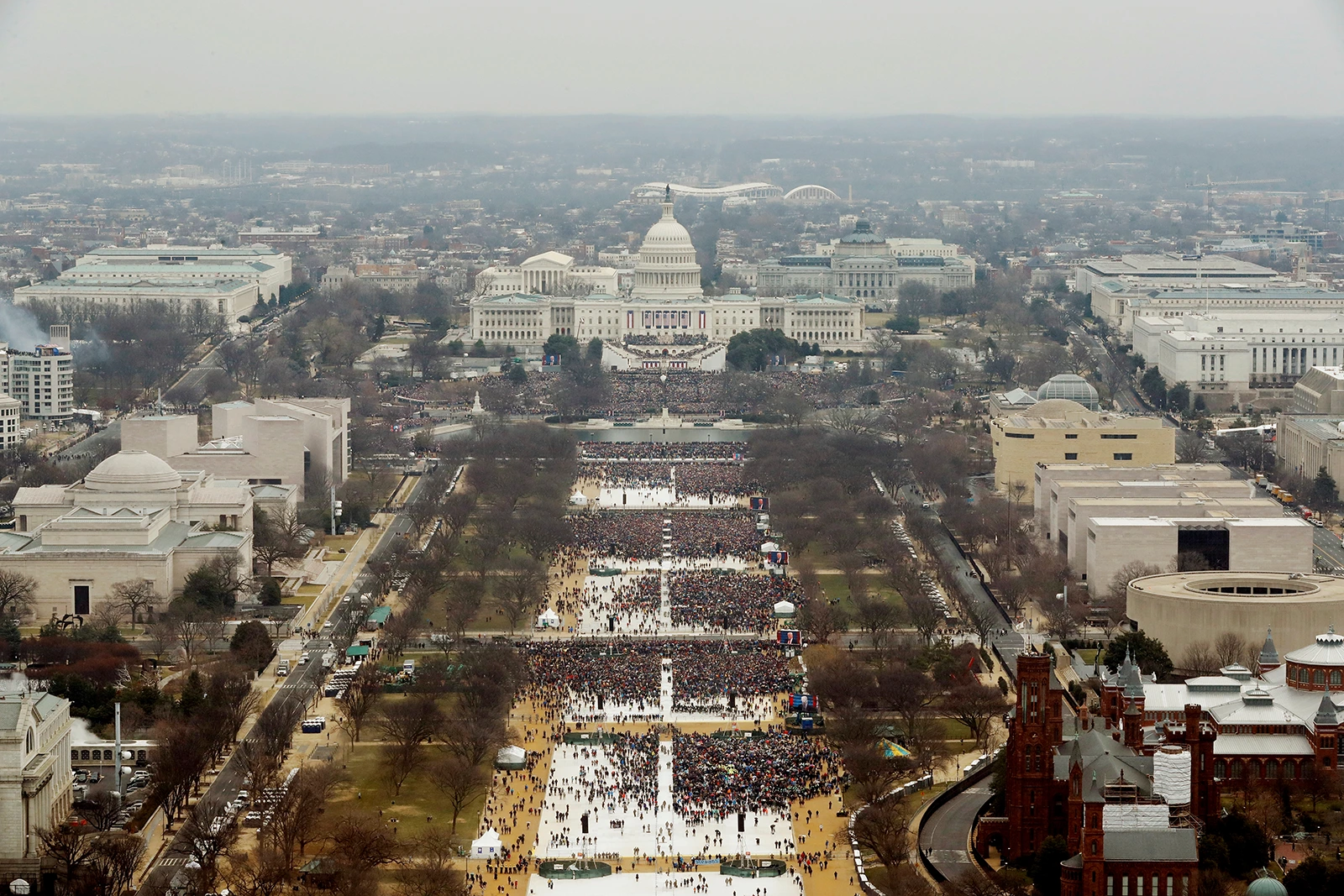
Under Trump, however, no one offers a mea culpa. The tone was set the day after Trump’s first inauguration, when Trump ordered his first press secretary, Sean Spicer, to claim that “his was the largest audience to ever witness an inauguration — period — both in person and around the globe.”

Spicer lashed out at reporters who accurately reported that the crowd for Trump was smaller than that for Barack Obama. He offered a series of easily disproven claims to back up his nonsense, such as that this was the first time that floor coverings were used on the National Mall.
Trump never dropped the crowd claim. Running for re-election in 2020, he bragged that “we had the largest audience anywhere in the world.” He even accused the media of showing photos from “five or six hours” before he started speaking.
Spicer’s credibility with the press was destroyed almost immediately. He was gone within six months, replaced by Sarah Huckabee Sanders — now the governor of Arkansas — who was more skilled at dissembling.

On several occasions, for example, Sanders told reporters that “countless” FBI agents had told her that they were thankful Trump had fired FBI Director James Comey. But when she was interviewed by Special Counsel Robert Mueller, she admitted this was “a comment she made ‘in the heat of the moment’ that was not founded on anything.” She described the lie as a “slip of the tongue.”
Funny how her tongue kept slipping. Over time, she all but ended the daily briefing, with gaps of more than a month as Trump seized the megaphone for himself.
Grisham, the press secretary who avoided the briefing room, later became a Trump critic and endorsed Kamala Harris in 2024. Addressing the Democratic National Convention that year, Grisham said, “I never held a White House briefing because, unlike my boss, I never wanted to stand at that podium and lie.”
Fast-forward to Leavitt and Trump’s second term. Except when she was on maternity leave, Leavitt kept to a regular schedule of at least one to two briefings a week, leaving no doubt she was a true believer in Trump. In a social media post on her resignation, Trump called her “one of the best White House Press Secretaries in the History of the Office.”
Press secretaries once worried that getting caught in a lie would destroy their credibility. In Trump’s White House, there is apparently no penalty for having none.
The post Karoline Leavitt knew exactly what she was doing appeared first on MS NOW.