After I watched “Michael,” the new Jackson estate-approved biopic that follows the King of Pop from his youth in Gary, Indiana, until he proclaims his independence from his notoriously imperious father in 1984, I took the New York subway home.
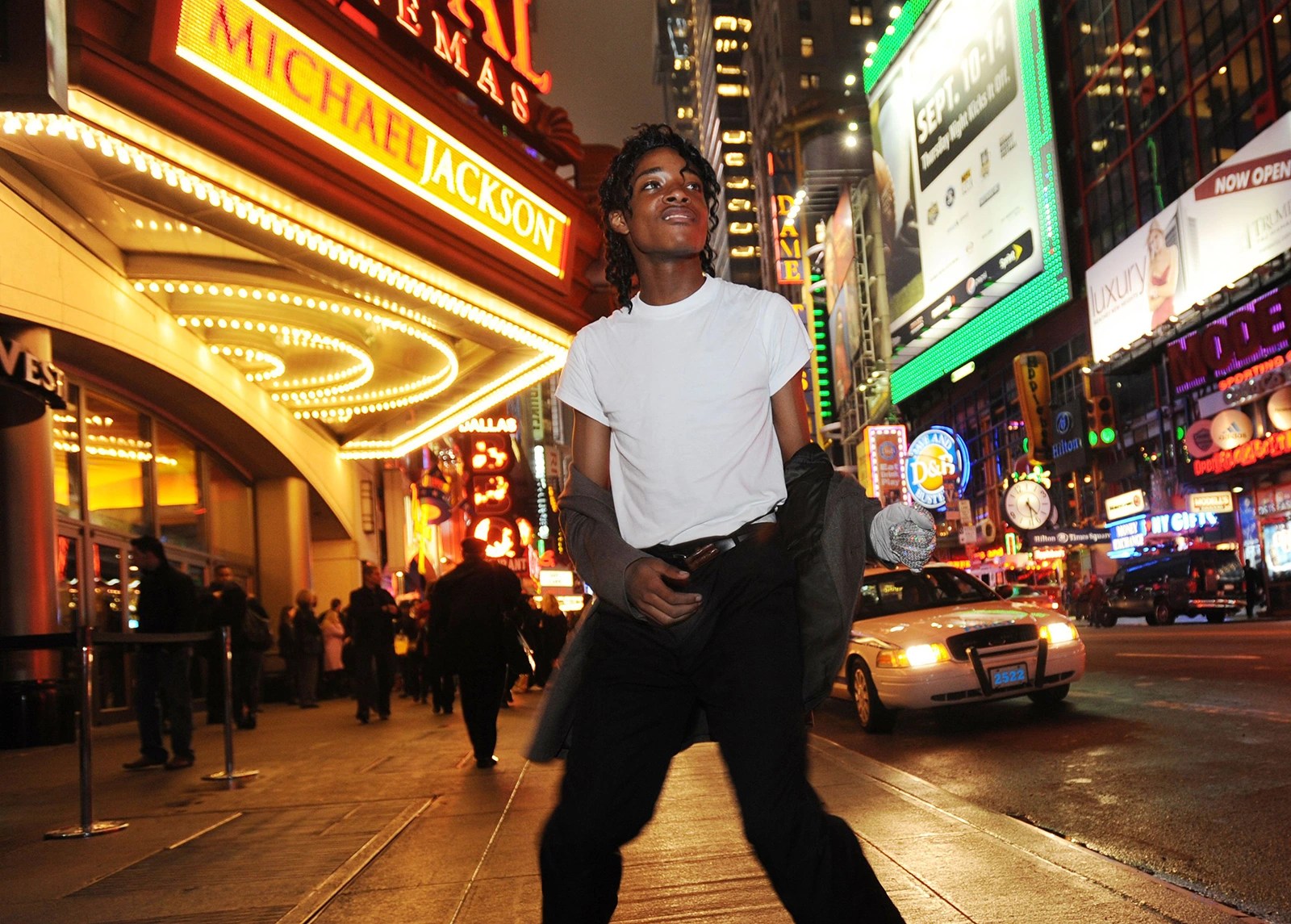
I could not stop thinking about Jordan Neely, a homeless Michael Jackson impersonator, who was in the middle of a mental health crisis aboard an MTA train on May 1, 2023. He died after Daniel Penny, a white U.S. Marine veteran, placed him in a chokehold. On the way home from the movie, I could not stop thinking about what we lose by choosing to turn away from ugly, difficult truths rather than engage them, and what we lose when we reject introspection.
I could not stop thinking about what we lose by choosing to turn away from ugly, difficult truths rather than engage them.
Other subway passengers captured what happened to Neely on cell phone video, but a second-degree manslaughter case against Penny was dismissed after a jury deadlocked. The same jury acquitted Penny of criminally negligent homicide. Penny was quickly hired by Andreessen Horowitz — also known as a16z — the venture capital firm cofounded by Donald Trump supporter Marc Andreessen, who recently said in a podcast interview that introspection is something he engages in “as little as possible.” He continued, “I find that people who dwell on the past get stuck in the past. It’s a problem at work and it’s a problem at home.”
Neely, an aspiring artist and performer, had turned to what had been Michael Jackson’s launchpad out of poverty: mimicry. Young Michael commanded attention and praise for his uncanny recreations of The Temptations, James Brown and Jackie Wilson. His youthful innocence and his precocious renditions of Motown hits attracted the attention of Suzanne de Passe, a creative assistant to Motown Records founder Berry Gordy. To those who witnessed his rise, Michael Jackson’s story made it seem possible to escape the gravitational pull of anti-Blackness and economic inequity in America — if one was cute, hardworking, and special enough. With a bit of luck, others could also vault themselves to the dreamscape of Neverland.

At least, that was a narrative that seemed plausible until a more grotesque reality was revealed through each surgical modification of Michael’s face and through his increasingly strange, erratic behavior — he married Elvis’s daughter! He dangled his new infant from a hotel balcony! He wore pajamas to court! Michael became a public joke, a genius eccentric who transformed himself into a garish alien weirdo the press called “Wacko Jacko.”
As allegations of child sexual abuse against Jackson surfaced in the 1990s, plausible deniability of knowledge of the alleged harm he was doing to children stretched ever thinner, until the veil finally ripped for good with the 2019 premiere of “Leaving Neverland.” In the HBO documentary, two of his accusers recounted their experiences of sexual abuse at his hands and the shattering effects it had on their lives. Oprah Winfrey, who had interviewed Michael on the “Oprah Winfrey Show,” told his accusers she believed them.
Much like Andreessen says he does, “Michael,” penned by John Logan and directed by Antoine Fuqua, shrinks from serious engagement with the past. They deliver a coming-of-age film painfully incurious about Michael Jackson’s interiority or the childhood experiences that may have informed his alleged abuses of others. “Michael” is, instead, what one imagines would result if a user prompted the now-defunct artificial intelligence video generation app Sora to spit out a feature film that speed-runs through the major plot points of the 1992 miniseries “The Jacksons: An American Dream” and intersplice it with high-octane recreations of Jackson’s performances as a child and young adult. Joe Jackson’s well-documented abuse of his son is little more than a plot device. Because the film ends in 1984, at the conclusion of The Jacksons’ “Victory Tour,” it is able to sidestep Michael’s alleged predations entirely.

Nia Long and Colman Domingo as parents Katherine and Joe Jackson give us little more than animatronic silhouettes drawn from the recesses of a public imagination acquainted with the story of the Jackson 5’s rise to fame and fortune. Long’s Katherine is a saintly, quietly suffering matriarch who dotes on her friendless son but is unable or unwilling to protect him from Joe. The movie depicts him as a violent, menacing, self-serving and cruel patriarch who treats his children as little more than chits in a zero-sum moneymaking enterprise.
“In this life, you’re either a winner or a loser,” Joe says to the family as they’re gathered around a dinner table, echoing with utter seriousness an ideology the satirical “Talladega Nights: The Legend of Ricky Bobby” skewered 20 years ago. In that movie, the emotionally absent father with a similar entrepreneurial tunnel vision tells his son, “If you’re not first, you’re last.”
The Jackson estate seems to have as little regard for the memory of young, victimized Michael as it accuses Joe of having had for him. In life, Joe turned Michael and the rest of the Jackson 5 into products, neglecting their emotional and developmental needs in service of profit. That much, the estate and “Michael,” are willing to concede.
But the Jackson estate has chosen to do the same, by mining the moneymaking assets left after Jackson’s 2009 death from a propofol overdose for monetizable content while continuing to avoid the question of whether the price the family paid for fame and fortune was too high. Jaafar Jackson, Michael’s nephew and son of Jermaine Jackson, may well be a talented artist in his own right, with his own voice and ideas. But with his film debut, now Jaafar too, is drawn into the Faustian bargain Joseph entered when he turned his children into revenue-generating extensions of his own ambitions and terrorized them into delivering his desired results.
The film’s entire draw is that its lead actor promises to be a visual and kinetic doppelganger of his dead uncle.
The film’s entire draw is that its lead actor promises to be a visual and kinetic doppelganger of his dead uncle, whose songs he lip-syncs. Whatever interests Jaafar may have as an individual have been sacrificed and subsumed into the project of propping up the Jackson estate money-printing machine. Given the circumstances, trotting out an AI Michael Jackson hologram, which the Billboard Music Awards did 12 years ago, seems more humane than consigning yet another generation to a macabre fate generated by capitalism, genetics and the weight of legacy.
“Michael” serves up a heady dose of exonerative nostalgia. That alone will be enough to coax dollars from the pockets of moviegoers hoping for a momentary escape from real life miseries. Stripped of character development and context, “Michael” does a disservice to Jackson as a creative and artistic genius — it is a film utterly incurious about his musical or psychological development, his personality, the engines of his statement-making aesthetic choices, his contradictions, the things that made him human.
Instead, “Michael” plays like a sizzle reel for investors, a thumping promise of frictionless narrative, designed for a populace that eschews introspection as little more than an inconvenience to profit. It’s a glittering billboard filled with empty promises to people as needy and desperate as Jordan Neely was.
The movie works much like a plastic surgeon, nipping and tucking at narrative and memory, obscuring the unsavory, until what’s left is a misshapen simulacrum, one that elides what we all know comes later: Michael’s grotesque unhappiness, bizarre coping mechanisms, and the way he ends up up hurting others drawn to his mythos and celebrity.
“Michael”is an artifact designed to capture the attention of a culture unwilling to engage honestly with the past or its ramifications for the present, commodifying the childhood innocence of its eponymous subject, while repeating and sustaining the very trespasses of its comically one-dimensional patriarch and villain.
The post The new Michael Jackson biopic tells us nothing about who he was inside appeared first on MS NOW.