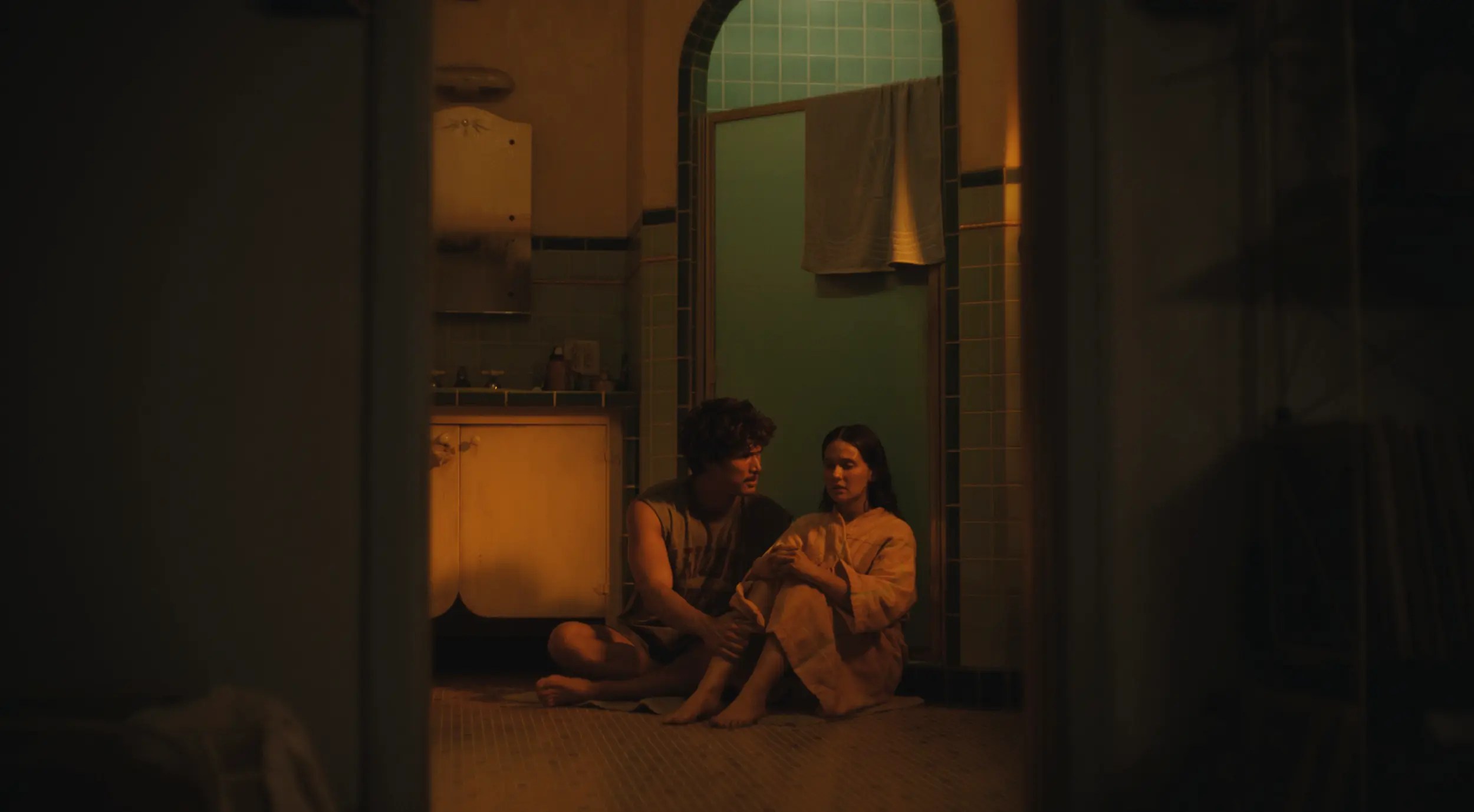
Season 2 of “Beef” follows the lives of two couples who work at a country club for the ultrawealthy and, because of their financial insecurity, are driven to extreme measures by their desperation. The club itself is a microcosm of our wider political and economic systems; the couples’ misery is the direct consequence of the grotesque inequality that immerses them, yet they also rely on the country club for their survival.
The hit Netflix show, which has sat on the platform’s Top 10 list since its release on April 16, is a meditation on late capitalism — the age of rampant consumerism and widening inequality that accompanied the globalization of the latter half of the 20th century —as the series explores the perversion and exploitation inherent to the system and its sustaining ideology. But what this season does most skillfully is tease out the pernicious lie that allows for late capitalism to remain unchecked: the lie that the system is natural.
It is both deeply uncomfortable and compelling to watch our worst and ugliest instincts on screen.
What this season does most skillfully is tease out the pernicious lie that allows for late capitalism to remain unchecked: the lie that the system is natural.
The second season of “Beef,” while not as good as the first, is still an enjoyable watch. Much like the last season, it has the feel of a car crash you can’t quite look away from. It is both deeply uncomfortable and compelling to watch our worst and ugliest instincts on screen. Like many others, I imagine, I simultaneously convince myself I could never be capable of such horrific behavior yet still find myself identifying with the characters.
That is the genius of the show. It shows us what we are capable of, as well as the internal polarization that horror produces. We want to look away, and yet we can’t. We tell ourselves we are not these people, and yet we see ourselves in them.
Social Darwinists subscribe to the idea that systems such as capitalism reflect the natural world and support processes like natural selection. This conflation of a (profoundly unjust) human-made system with nature makes that system seem inevitable, as opposed to constructed and therefore contestable.
The second season of “Beef” exposes this lie.
Several characters deliver their own soliloquies on capitalism, with notably disparate interpretations informed by their place in the pecking order. The poorest of them see the ills of capitalism clearly and make note of its exploitation, while the richest herald it as an extension of nature.

There is a moment in Episode 1 when Ashley (Cailee Spaeny), an unskilled worker who never finished high school and lacks health insurance, discovers she has an ovarian cyst and needs surgery to avoid it threatening her life and severely compromising her ability to have children. Distressed, she turns to her fiancé, Austin (Charles Melton), for support. In a comical and kitschy moment, Austin — a pretty jock and perhaps the dumbest character on the show, who seems to have about three brain cells and the legs of a Greek god — offers a polemic on the conditions that have led to this crisis.
“Late-stage capitalism — it’s all about fighting it, right? … The system is designed to make you feel despair. Like, the disparity is systemic, you know what I mean? … None of this is your fault, OK? The people in charge have made it impossible for us.” Austin continues, “Sometimes I can get down about it, but then I remember that we work at a f–––ing country club, where everyone grabbed the bag before we could; of course we feel this way.” He concludes by calling for global wealth distribution.
Thus, Austin lays out the show’s thesis for us.
But set this against the law-breaking, billionaire antagonist Chairwoman Park (Youn Yuh-jung), who owns the country club and seems to have everyone under her thumb, including law enforcement. In a speech in the final episode, she has a very different take:
My second husband always said, ‘Love is putting other person over yourself.’ But as soon as you are born, you cry for mommy’s milk. You do not care about her. You only care about yourself. Maybe you put others over self a few times, but only when it is easy. The universe is not designed for this. Thank god we survived billions of years from tiny cell to bacteria to monkey because we only care about self. That is why capitalism works. It is a system of nature. System of the self. Love lives in this system. All relationships exist in this system. They’re all the same, another way to serve the self.

What Park fails to see is that the natural world has a homeostasis to it. Wild imbalances of the sort analogous to obscene wealth inequality are naturally corrected. What’s more, she inverts the causal relationship: It’s not that capitalism honors the natural instinct to preserve the self above all else; it is, in fact, a system that demands it.
In Episode 6, country club general manager Josh (Oscar Isaac) delivers his own meditation on capitalism to Austin in an emotionally vulnerable state after a psychedelic drug experience (which left many viewers wondering what the hell “bufo” is). He warns Austin that you may be so busy trying to survive that one day you’ll wake up only to realize just how spiritually and emotionally impoverished you are. There is no space or time for your own humanity, for meaningful connection with yourself and others.
When the two couples become embroiled in Chairwoman Park’s twisty, shadowy and violent world, they are caught by her henchmen and separated in pairs, and find themselves in a classic prisoner’s dilemma. Josh ultimately disrupts it by sacrificing himself to save his partner, Lindsay (Carey Mulligan), and by extension the other young couple, too. His actions refute Park’s cynical take on what is “natural” — that the self comes before anything or anyone else.
The tension between sacrificing the self for the collective and sacrificing the collective for the self is a through line of the season.
The tension between sacrificing the self for the collective and sacrificing the collective for the self is a through line of the season. Ants are a common motif, for example. At first glance, this could be interpreted as an endorsement of Park’s take: Ant colonies, like late capitalism, are deeply hierarchical; the system’s complexity makes it a brilliant metaphor. But unlike people following the demands of capitalism — placing the self above all else — ants are keen to sacrifice themselves for the sake of the collective. (Sick young ants, for instance, “will send out an altruistic ‘kill me’ signal for the worker ants who tend to them” so as not to spread disease to the colony, according to an NPR report.)
Despite Park’s claims, the hyperindividualism and gross inequality of late capitalism is in fact antithetical to our survival. We are entering a climate disaster at full throttle, a consequence of our economic system and the vast inequality late capitalism engenders. It has created an environment that nurtures many more horrors, like the rise of fascism and multiple genocides.
Just as it does in real life, the main characters’ obsession with either acquiring wealth (to meet basic needs) or maintaining wealth leads everyone to act in ethically compromising, sometimes perverse ways. There is nothing natural about late capitalism, the show suggests. And it takes us away from the most natural instinct of all: love.
The post ‘Beef’ Season 2 reflects our ugliest, most human instincts. And we can’t look away. appeared first on MS NOW.