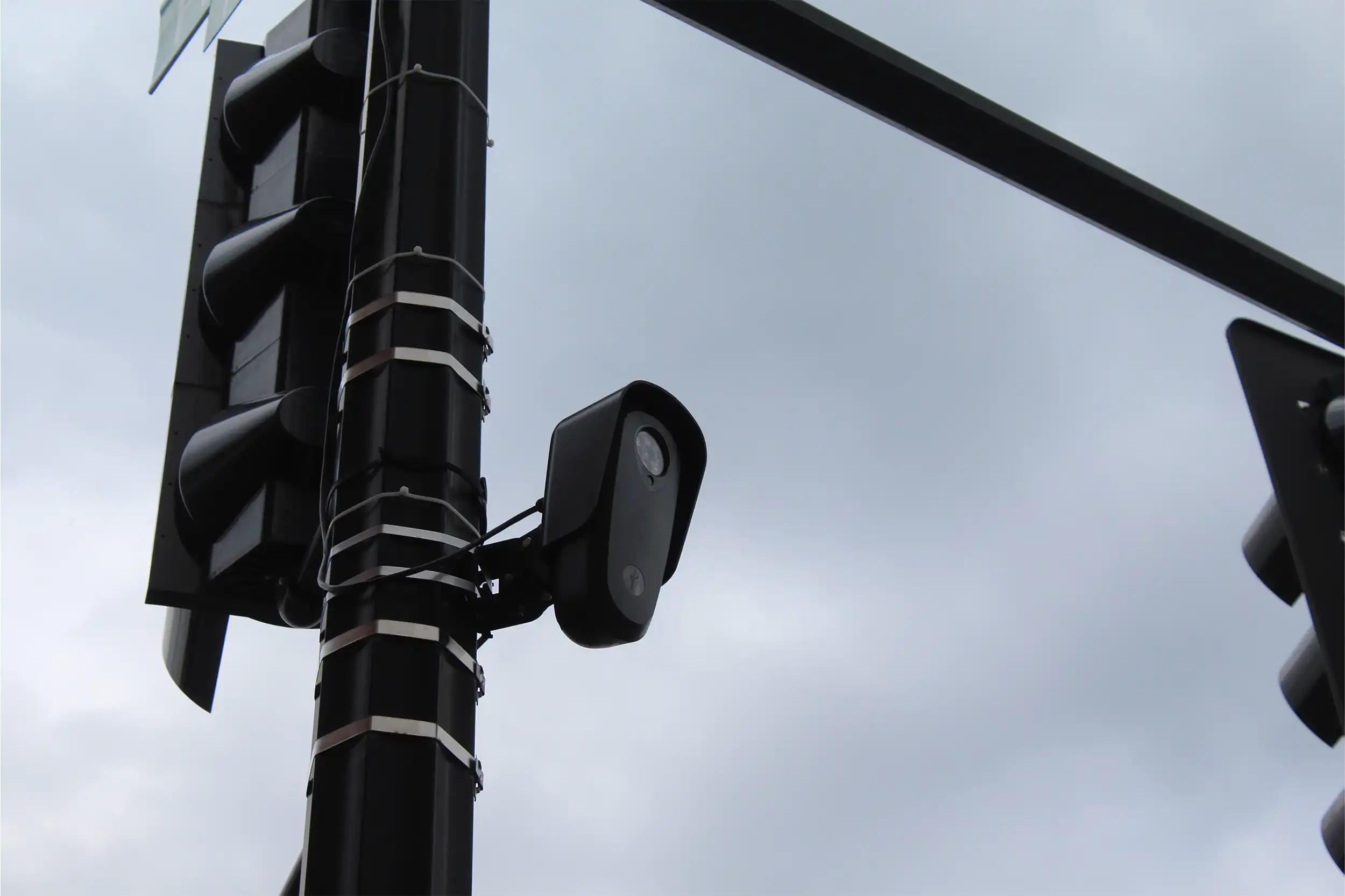
Flock Safety’s artificial-intelligence-powered license plate readers and surveillance systems have proliferated in the United States over the past few years, prompting national concern about privacy and a bipartisan backlash that has created some unlikely — if temporary — alliances between otherwise ideologically opposed lawmakers and political hopefuls.
They include Pennsylvania Republican Rep. Scott Perry and Michigan Democratic Senate candidate Adbul El-Sayed. The two couldn’t be farther apart on the political and ideological spectrum. Perry once led the House’s ultraconservative Freedom Caucus and pushed the “great replacement” conspiracy theory touted by white nationalists; El-Sayed is the first Muslim nominated by Democrats for U.S. Senate and a progressive running on the issue of Medicare for All. But when it comes to what to do about Flock’s nationwide surveillance network, the pair have seemingly found common ground.
Earlier this month, El-Sayed posted a video to his social media accounts accusing his opponent, former Republican Rep. Mike Rogers, of supporting privacy-violating policies during his time as chair of the House Intelligence Committee. In the ad, El-Sayed ties Rogers’ comments — “You can’t have your privacy violated if you don’t know your privacy is violated, right?” — to the Flock camera debate and implores Michiganders “to stand up to this massive surveillance apparatus.”
El-Sayed’s campaign has even given Rogers a Flock-themed nickname — “Mass Surveillance Mike” — spokesperson Cole Wozniak told MS NOW. “Abdul has heard concerns about Flock cameras from voters in every corner of the state,” Wozniak said.

The campaign’s language is remarkably similar to that used by Perry in a series of Facebook posts this summer. He repeatedly called on Congress to “Stop the Flock” and said Americans should not be forced to choose between their safety and their Fourth Amendment rights.
Perry, along with Rep. Jesús García, D-Ill., attempted to ban the use of federal highway funds for license plate readers with an amendment to a bipartisan House bill in May, but the legislative addition ultimately died in committee. Perry’s office did not respond to multiple requests for comment on this story.
El-Sayed and Perry aren’t alone in their opposition to the technology. This summer, candidates across the country and from different points on the political spectrum have centered major parts of their messaging around stopping Flock from digging in further to local communities and law enforcement agencies.
Flock Safety is virtually everywhere. Its cameras are in New York, Chicago, Boston, Los Angeles — just about every major city in the U.S. It has a camera across the street from the White House, and one watching Culbertson, Montana, a town of just 753. The company has nested its surveillance system in every state but Alaska — the cameras have even crossed the gulf to Puerto Rico.
DeFlock, a watchdog group that tracks Flock cameras from open-source data, has identified more than 135,000 of the cameras across the country. The majority — about 82% — are Flock Safety cameras, while 13% are operated by about 100 smaller companies. The DeFlock website says that Flock’s AI tracks more than just license plates — it also identifies a car’s make, model and color, and can tell if a vehicle has any scrapes, dents, stickers, decals or attachments, such as roof and bike racks.
Proponents of the system say that for law enforcement agencies tied into Flock’s network, which DeFlock estimates to number about 6,400, the national database allows for faster crime solving that keeps communities safe.
Critics, meanwhile, argue that Flock is a violation of their basic constitutional privacy rights. Of those 6,400 agencies, the watchdog estimates that just 900 run a public transparency portal, while only 530 of those publicly disclose who they share data with.
“The rest redact their sharing list or don’t publish one at all,” according to DeFlock’s wesbite.
Loreal Hawk, a civil rights attorney who is a member of DeFlock D.C., told MS NOW that interest in the anti-surveillance-camera movement grew this summer. At the chapter’s first major in-person event earlier this month, there were more attendees than seats in the room.
“People definitely feel the crunch of affordability,” Hawk said. “And to then find out that your city is willing to spend $10 million-plus on Flock cameras instead of housing subsidies … you’re like, why? Why are my tax dollars going here?”
Flock’s efforts to moderate the public’s vitriol toward its products have been hampered by recent reporting by The Washington Post that revealed that at least 50 law enforcement officers in the U.S. have been charged with or accused of misusing Flock and similar surveillance systems to stalk or harass civilians, many of whom were women. Flock representatives did not respond to a request for comment on this story.
Flock Safety CEO Garrett Langley has tried to mitigate the waves of critiques facing his company, to little avail. In an Aug. 22 Fox News interview, Langley said that in the debate between safety and privacy, “what we have to prioritize as a country is compromise.”
In response to the Post’s findings, Flock told the paper that it would “soon be announcing better filters and tools to stop abuse before it happens.” But local, state and federal lawmakers have already taken steps toward reining the company in.
In the House, Rep. Tim Burchett, R-Tenn., introduced the Protection Against Mass Surveillance Act to ban the federal purchase of Flock cameras, which he calls “unconstitutional.” Reps. Josh Brecheen, R-Okla., and Victoria Spartz, R-Ind., both signed on as co-sponsors. An independent running against Burchett, Adam Heimerman, was arrested and charged with four counts of felony vandalism last month for allegedly shooting four Flock cameras.
A few counties over, Columbia, Tennessee, Mayor Chaz Molder, who is running to replace outgoing GOP Rep. Andy Ogles, said “big government overreach has no place” in his state. Other Democrats, like House candidates Kristina Knickerbocker of Ohio and William Lawrence of Michigan, have also come out against Flock. Troy Jackson, the Democratic Senate candidate in Maine, did so during his ill-fated gubernatorial bid earlier this summer.
In a video posted to Facebook, Jackson says Flock cameras “should be illegal.” Jackson, like both Perry and El-Sayed, is running in a tight race many pollsters consider a toss-up. To win, all three will likely need to win voters from across the aisle. Championing a bipartisan cause like Flock bans could help them do that.
The effect can be seen in Arizona, where the state’s gubernatorial candidates have split on the issue. Republican Andy Biggs wants to ban automated license plate readers, or ALPRs, calling them a “gross violation” of a free society, while incumbent Democratic Gov. Katie Hobbs said she would not sign a statewide ban on them. In a rare sight, Tempe, one of Arizona’s bluest cities, found itself siding with the Republican.
On Wednesday, Tempe shut off its license plate reader surveillance systems and said in a statement that “while the cameras have helped Tempe Police solve crimes,” recent abuses of surveillance systems in the state like Flock’s “raised concerns about the risks that come with the technology.” The city added that it found no record of misuse within its own police department.
The political alliances forged over the Flock issue may be unusual, but they are not surprising, Hawk told MS NOW. Hawk explained that privacy debates can be meeting grounds for progressives, who approach privacy as a civil rights issue, and conservatives, who have historically opposed “big government” policies like mass surveillance.
In a letter sent to Flock’s CEO last week, Sen. Josh Hawley, R-Mo., informed Langley that he is investigating the company’s “collection, retention, and dissemination” of data its AI systems collect.
“Congress never authorized the network your industry has built. Your company’s internal policies are, in practice, the only safeguards for hundreds of millions of Americans,” Hawley, the chairman of the Senate Judiciary Subcommittee on Crime and Counterterrorism, wrote in the letter. “The American people want to know who has access to their personal data and how. This investigation will seek those answers.”
Hawley demanded that Flock produce relevant documents to the subcommittee by Sept. 8. If the company opts to voluntarily withhold the information, Hawley could seek a subpoena to force its hand.
To do so, Hawley would need Democratic votes, but if this midterm cycle is any indication, crossing the aisle on this particular subject may not be a tall order.
The post The bipartisan fight against Flock cameras is creating some unlikely political alliances appeared first on MS NOW.