President Donald Trump built his political identity on the art of leverage. He arrived in Beijing with precious little of it.
A string of geostrategic missteps he made over the past year — undermining U.S. alliances, starting a costly trade war and attacking Iran — has left the president in a weakened position heading into a high-stakes summit with Chinese President Xi Jinping, foreign policy experts say.
“He comes at a much-reduced capacity,” said Aaron David Miller, a veteran diplomat and foreign policy expert with the Carnegie Endowment for International Peace.
And Beijing is aware of it, analysts say.
“China’s leadership is genuinely confident about its ability to out-maneuver President Trump and gain the upper hand over the United States on China’s core foreign policy interests,” Scott Kennedy, a senior adviser on Chinese business and economics at the Center for Strategic and International Studies, wrote in a recent analysis. “It is also a result of the United States’ own missteps.”
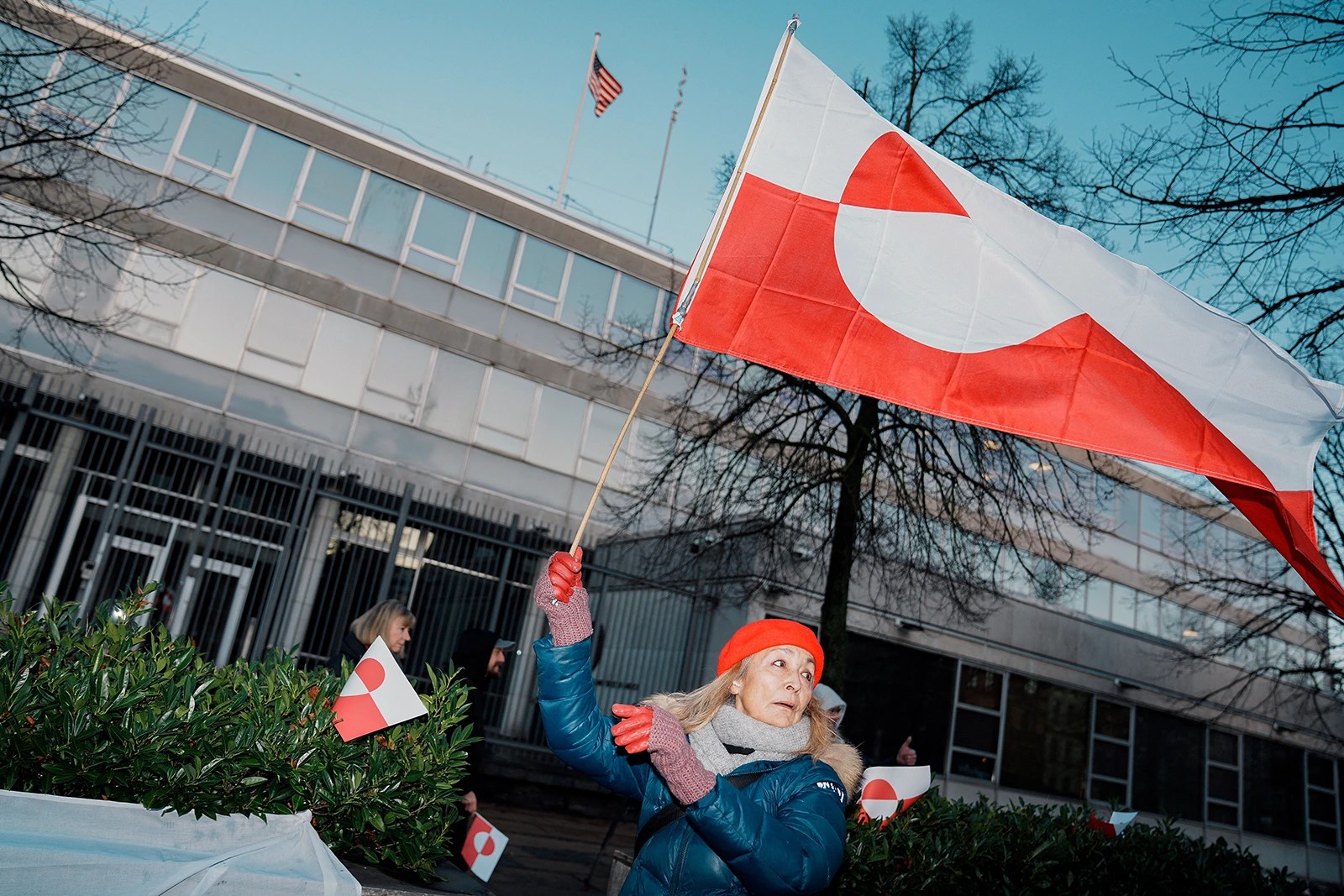
Coveting Greenland

Weeks before taking office for his second term, Trump began publicly demanding that the U.S. be allowed to annex Greenland, an autonomous territory of Denmark. He threatened to “tariff Denmark at a very high level” if it did not allow the U.S. to take control of Greenland. “They should give it up, because we need it for national security,” he said.
Over the next year, Trump insisted that full U.S. ownership of Greenland is “psychologically needed for success,” argued that “the World is not secure unless we have Complete and Total Control of Greenland” and hinted that U.S. forces would invade the island.
The episode came to a head in a meandering speech at the World Economic Forum in Davos, Switzerland. Trump hectored and threatened European leaders, falsely claimed that Greenland was already a U.S. territory and repeatedly confused Iceland and Greenland. Canadian Prime Minister Mark Carney, whose country Trump had also suggested should become a U.S. state, publicly defied Trump, suggesting that America’s policy changes amounted to a “rupture in the world order” and “the beginning of a harsh reality … where the large, main power … is submitted to no limits, no constraints.”
Trump “has undermined American alliances,” Miller said of Trump’s prolonged and aggressive attempt to acquire Greenland.
A trade war

Trump’s second major geostrategic misstep was launching a trade war with China, according to Gregory Brew, a senior Iran and oil analyst at the Eurasia Group.
“Trump is dealing with the fallout of his ill-conceived trade war with China from last year,” Brew told MS NOW.
A month into his second term, Trump imposed an additional 10% tariff on goods from China, citing claims that Beijing had done too little to stop the flow of chemicals used to make fentanyl. After both countries enacted tit-for-tat tariffs — which rose to as much as 145% — Trump backed down after stock market declines and a near halt in Chinese purchases of American soybeans. In 2025, China bought almost $50 billion less in U.S. products than it did in 2022.
Miller said a recent Supreme Court ruling that Congress — not the president — had the power to levy tariffs had further weakened Trump. “What is really going to hurt him is SCOTUS ruling on tariffs,” Miller told MS NOW. “That diffuses one of Trump’s greatest levers just as he arrives in Beijing.”
Attacking Iran

Trump’s third and potentially most consequential misstep was in his apparent belief that air power alone would cause the Iranian regime to collapse or capitulate. His administration also failed to anticipate that Iran could seize control of the Strait of Hormuz — a major strategic blunder that has reverberated globally.
For weeks, Trump has said that Iranian forces have been decimated and the country’s new leaders are hiding. Iranian officials insist that is false. Whatever the underlying reality, talks between the two sides remain deadlocked.
On the day Trump departed Washington for Beijing, new data showed the highest increase in inflation in two years, fueled primarily by a 17.9% jump in energy costs tied to the strait’s closure. Core inflation, which excludes food and energy costs, also rose to 2.8% — a seven-month high.
Before boarding Air Force One, Trump sent conflicting signals about whether he would even raise Iran with Xi.
“We’re going to have a long talk about it. I think he’s been relatively good, to be honest with you,” Trump said.
Minutes later, he suggested he would not talk about Iran at all with Xi. “We have a lot of things to discuss,” Trump said. “I wouldn’t say Iran is one of them, to be honest with you, because we have Iran very much under control.”
Miller said that as the war drags on, the risks of a U.S and global recession caused by Trump is steadily growing. As a result, the president’s political power is ebbing both at home and abroad.
“He comes at a much-reduced capacity,” Miller said. “Trump is now responsible for what could be a global recession. The war and the impasse have put Xi, in my view, in the driver’s seat.”
The post The 3 geostrategic mistakes that weakened Trump before Beijing appeared first on MS NOW.