WEST PALM BEACH, Fla. — House Democrats took the Epstein investigation to President Donald Trump’s doorstep on Tuesday as they held hearings with survivors, their families and other advocates near the president’s Mar-a-Lago estate, and not far from Jeffrey Epstein’s own home where he sexually abused girls.
Rep. Robert Garcia, D-Calif., the ranking member on the House Oversight Committee, which has been leading the charge in Congress, said that Democrats are “launching a new phase of the Epstein investigation.”
That includes releasing a new report that Democrats say details how the nonprosecution agreement negotiated by Alex Acosta, the former U.S. attorney for the Southern District of Florida, allowed Epstein to “continue and expand his trafficking operation,” according to the report. That nonprosecution agreement allowed Epstein to serve 13 months in jail after pleading guilty to a single state count of solicitation of prostitution and registering as a sex offender.
Garcia said the new report is the first of many that Democrats intend to release over the coming months featuring both Oversight Committee material and information gleaned from the informal cooperation of witnesses, survivors and whistleblowers.
The California Democrat decried the “continued cover-up” by the government, which he says “continues to defy the law.”
Garcia says the government is withholding as much as half of the Epstein files in its possession, intended to be made public after Congress passed the Epstein Files Transparency Act. The Justice Department released millions of pages of Epstein-related files, but it significantly redacted those pages and withheld millions of others, saying the department needed to protect ongoing investigations and attorney-client privilege, among other things.
The field hearing by Oversight Democrats — to which Republican lawmakers were not invited — comes as the Epstein investigation, which has been a political headache for Trump, has reached a turning point. The Justice Department says it has complied both with a bipartisan congressional subpoena and with the Epstein Files Transparency Act. The law called for the release of almost all of the documents related to the department’s investigation of the wealthy financier, who authorities say died by suicide while in jail in 2019, and his accomplice, Ghislaine Maxwell, who is serving a 20-year prison sentence for conspiring with Epstein to abuse minors.
Neither the Justice Department nor the office of Rep. James Comer, R-Ky., immediately responded to requests for comment.
House Democrats — who have worked to keep the Epstein case in the spotlight — believe there is more to reveal.
And Tuesday’s hearing demonstrated how much the public still has to learn. A survivor identified only as “Roza” came forward for the first time, testifying that she was an 18-year-old model from Uzbekistan when she moved to New York in 2008 and quickly fell into debt to her modeling agency, which was run by Epstein associate Jean-Luc Brunel. (Brunel died in 2022 while in French custody awaiting trial for sexual assault.) Epstein then offered her a job as an assistant at his foundation in Palm Beach.
For three years, Epstein raped her, Roza testified, including in 2009, when he was under house arrest through his plea deal. She also said that because of Epstein’s influence, she very quickly received a type of visa that is reserved for people of extraordinary abilities — and she understood that if he was displeased with her, he could and would take it away.

But her relationship with Epstein himself was not the end of her trauma, Roza explained. When the Epstein files were released, she said, she discovered her name was mentioned more than 500 times. “Reporters across the globe” now contact her, she said, and she cannot live “without looking over my shoulder.”
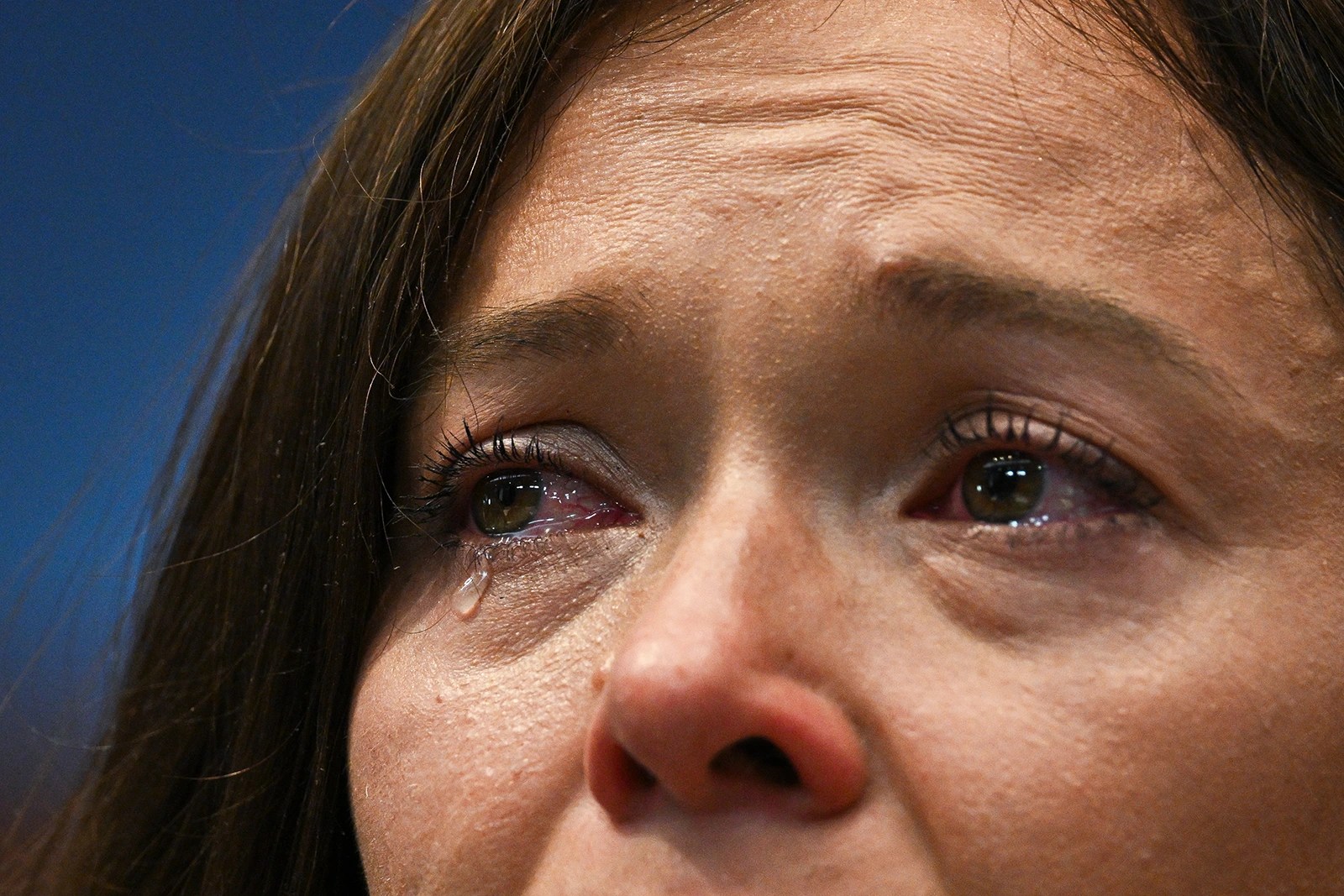
When she was done testifying, Roza collapsed into sobs and was held by Danielle (Dani) Bensky in a powerful show of how the survivors, in the absence of careful handling by prosecutors, care for one another.
Tuesday’s hearing also featured video testimony from Maria Farmer, who says she reported her abuse by Epstein and Maxwell to the FBI in 1996, and the family of Virginia Giuffre, a deceased survivor of Epstein’s abuse who said she was recruited into his orbit while working at Mar-a-Lago in 2000.
In the emotional video, Farmer said she couldn’t testify in person because she was recently released from the hospital as she battles two forms of cancer and other illnesses. Farmer said she filed numerous Freedom of Information Act requests with the government for records pertaining to her case but was ignored repeatedly.
She cried in recounting how she discovered fragments of the record of her 1996 report to the FBI among those files released by the Justice Department, but she asked: “Where is my full report?”
Epstein survivor Maria Farmerpste cried in recounting how she discovered fragments of the record of her 1996 report to the FBI among those files released by the Justice Department, but she asked: “Where is my full report?”
Several other survivors testified along those lines, saying they had been frustrated by the government’s unresponsiveness or what they characterized as outright mistreatment.
Courtney Wild, who says she was 14 when Epstein began abusing her, was the lead plaintiff in the survivors’ efforts to enforce the Crime Victims’ Rights Act, which gives victims specific rights during criminal proceedings. But a federal appeals court ultimately ruled that the statute didn’t apply to Epstein’s victims because he had not already been charged federally at the time his lawyers negotiated the nonprosecution agreement and plea deal.
Wild advocated for amendments to the law, including clarifying what it means for prosecutors to consult with victims and when those rights should begin. She also asked the members to consider what transpired between 2008 and Epstein’s death in 2019 as she fought a losing battle for the government to undo Epstein’s nonprosecution deal. “Do you know how many other girls Jeffrey abused during that time period?” she asked. “I’ll bet the FBI does.”
“Don’t let this work be in vain,” she pleaded.
Jena-Lisa Jones, who also says she was abused by Epstein in Palm Beach beginning at age 14, pleaded with lawmakers to pass legislation allowing them to seek restitution after the Justice Department revealed some of their private information in its Epstein documents dump.
Jones also insisted that lawmakers should not force survivors to testify but instead should learn their stories from the available public record and through confidential conversations.
Jones also told lawmakers that Congress should pass legislation to mandate that children receive age-appropriate information about how to recognize and report child sexual abuse, saying that as a teen she lacked the language and resources to advocate for herself.
“Real change requires leadership at a national level,” she said.
Bensky, who says she was abused as a teenager by Epstein, added that her 2008 interview with the FBI felt like an “interrogation.”
She said she had no lawyer and no advocate and was terrified, especially given that Epstein had already told her that if she spoke to law enforcement, he would hurt her. She sought redactions of her personal identifying information in advance of the release of the Epstein files by the DOJ, but her name, phone number and other identifying details were publicly released.
Bensky, who has spoken publicly and with media in recent months, made clear that she wasn’t just talking about the harms to herself. “I am public,” she noted, but the name of a woman who is not and who “never, ever wanted to be exposed was revealed” through records of Bensky’s own interview with the FBI, she explained, crying.
Sydney Reynolds contributed to this report.
The post House Democrats hold hearing with Epstein survivors, declare probe is in ‘new phase’ appeared first on MS NOW.