Between 1910 and 1970, an estimated six million Black people left the South, changing the region from a place where almost all Black Americans lived to one where slightly more than half did. Even so, I was born the child, grandchild and great-grandchild of Mississippians who stayed put. And like the frog who reliably croaks for its own pond, I was defensive of Mississippi, defensive of the South and I resented those who suggested we lacked the good sense to leave.
Medgar Evers, the field secretary of the Mississippi NAACP who was assassinated in the driveway of his Jackson, Mississippi, home in 1963, had a deep love for Mississippi and once said, “I don’t know if I’m going to heaven or hell, but I’m going from Jackson.” My father, Melvin DeBerry, has long expressed a more cynical reason for staying: “At least the white man in the South will tell you what he thinks about you.”
I was defensive of Mississippi, defensive of the South and I resented those who suggested we lacked the good sense to leave.
“Y’all need to shut up, boy!”
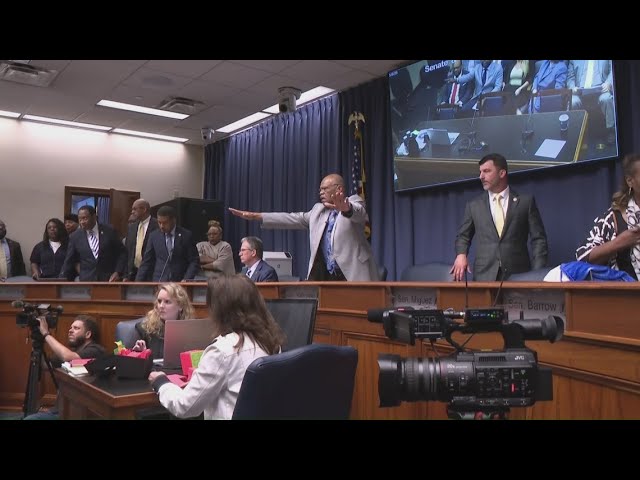
Dadrius Lanus, a Black man who serves as Louisiana’s Democratic Party executive director, said that’s what state Sen. Jay Morris, a white Republican, said to him May 8 during a redistricting committee hearing at the Louisiana State Capitol. Morris and his party were gleefully redrawing the state’s congressional map in a way that will hinder Black people’s political power and, for good reason, Black people in the room weren’t being quiet about it.
Morris denied using a pejorative, and a Baton Rouge TV station said it only captured him saying, “Y’all need to shut up” as he walked out of the committee room. (The word “boy” is not clearly audible in a video of the exchange posted by the Louisiana Democratic Party.) But Lanus said he heard it directly: “He said, ‘Y’all need to shut up.’ Then, he looked me in my eyes and said, ‘Y’all need to shut up, boy.’”
“Boy” or no “boy,” Morris telling Black people to shut up is offensive, but the greater, more lasting offense is the map itself. (The current proposal strips the state of one of its two majority Black congressional districts.) Rather than acknowledge that, Morris suggested that what’s being said about him is worse than what he is doing to Louisiana’s Black voters.

“The falsehood attributed to me has been very hurtful to me and my family,” Morris told the assembled Louisiana Senate on Monday. According to a news report, Morris then took a long pause “apparently to hold back tears.”
He’s not the victim here. Black voters are. Not only because of him, but also because of the U.S. Supreme Court, which in last month’s disastrous ruling in Louisiana v. Callais gave states permission to dilute Black political power as they see fit.
When I was growing up, my dad’s sister Mary regularly led the choir at our Baptist church in the Black gospel version of “This World Is Not My Home.” The song’s message is one of hope: There’s a heaven after all of this.
Last month’s disastrous Louisiana v. Callais ruling gave permission to the states to dilute Black political power as they see fit.
But since last month’s Supreme Court ruling, I’ve heard it differently. White Southern Republicans are feeling a wind at their backs stronger than any since the federal government abandoned Reconstruction, and that song’s refrain — “I can’t feel at home in this world anymore” — has played on a loop in my head.
But not because I’m hopeful.
I’ve never lived in a South without a Voting Rights Act that restricted white officials’ worst impulses.
And now that I do, home is feeling a lot less so.
These particular Republicans sound like the Redeemers, the white supremacists who rushed to strip Black people of their political positions and political power as soon as Reconstruction was over.
Republicans in Tennessee, by splitting into three a congressional district centered on majority-Black Memphis, have made it next to impossible for Black people in that state to elect someone to Congress. South Carolina may soon redistrict Rep. James Clyburn, the state’s only Black member of the House and a former chairman of the Congressional Black Caucus, out of his seat. Mississippi Gov. Tate Reeves called the tenure of Rep. Bennie Thompson, the state’s only Democrat and only Black member of its congressional delegation, a “reign of terror.” The Alabama House Speaker said he hopes the “Supreme Court will overturn Amendment 14.”
On April 30, Louisiana’s MAGA Gov. Jeff Landry signed into law a bill Morris drafted that eliminated an office that Calvin Duncan, a Black man, had just been elected to but had not yet been sworn into. The mayor of majority-Black New Orleans, five council members and the district attorney rightly objected, and they called for a special election. The Republican attorney general has threatened to have all those officials forcibly removed and replaced with politicians of Landry’s choosing.
There’s a long list of similar moves being made by white Republican officials across the South. Even if they don’t explicitly say it, “Shut up, y’all” is always implied.
Southern Republicans seem to believe they can be exonerated of accusations of racism by calling what they’re doing an attack not on Black people, but on Democrats. And the Supreme Court has given them cover with its ruling that racial gerrymanders are forbidden but partisan gerrymanders are OK.
Even if they don’t explicitly say it, “Shut up, y’all” is always implied.
But race and party are near proxies for each other in the South and, beyond that, there’s convincing research that “voters’ race is a more reliable predictor than their party of how they will vote in the next election.”
“How do you make that [racial or partisan] distinction in the South?” I asked my uncle, Roy DeBerry, on Wednesday.
“You can’t,” he said.
My 78-year-old uncle has a Ph.D. in political science and government; he’s worked in state and local governments, taught at the college level and served as a university vice president in Mississippi. But even more significantly, he was on the front lines of the Civil Rights Movement at least a year before there was a Voting Rights Act. He and my dad participated in protests in Mississippi, but as a baby-faced teenager, my uncle picketed outside the 1964 Democratic National Convention in Atlantic City demanding that the integrated Mississippi Freedom Democratic Party, and not the all-white Mississippi Democratic Party, be recognized as the real delegation.

The goal then was the same as it is now: a multiracial democracy. The Voting Rights Act, signed into law a year after my uncle picketed on the Atlantic City Boardwalk, made that a possibility. I don’t know to what extent the Voting Rights Act had in ending the Great Migration, but it for sure made life for Black people in the South more tolerable. But now, the Supreme Court has made multiracial democracy harder to accomplish and Black people in the South have to brace themselves for harder times ahead.
“People don’t understand history,” Uncle Roy said during our chat Wednesday. “The Supreme Court has never been your friend.” He noted 1954’s Brown v. Board of Education as an exception but said otherwise change has come “because of people deciding to engage and put the pressure on, get Congress to do what it needs to do and then the Supreme Court sort of lags behind. The same thing is true now. People say, ‘Oh, we’re shocked that the Supreme Court ruled the way it did.’ I’m not shocked at all.”
The Supreme Court has never been your friend. People say, ‘Oh, we’re shocked that the Supreme Court ruled the way it did.’ I’m not shocked at all.
roy deberry
At one point during our conversation, I began a question with “What do you think is next —” but before I could say everything I intended, he interjected: “Struggle.”
“How long that struggle will take to get this thing reversed? I have no idea. But I know one thing: It’s not going to happen automatically. It’s never happened automatically in America.”
Because I’m struggling with my own place in the South, I asked him why, after getting his doctorate from Brandeis, he didn’t stay in the Boston area. Why did he come back home? He began by talking about where he thought he could have the most impact, but eventually he arrived at an answer that’s consistent with what Medgar Evers said: “Fundamentally, I’m a Southerner.”
As am I. As are the Black people who have been raising their voices against the concerted attempts from white Republicans to shut us up and make us feel like the South is not our home.
The post ‘Fundamentally, I’m a Southerner;’ how a SCOTUS ruling complicates Black voters’ sense of place appeared first on MS NOW.