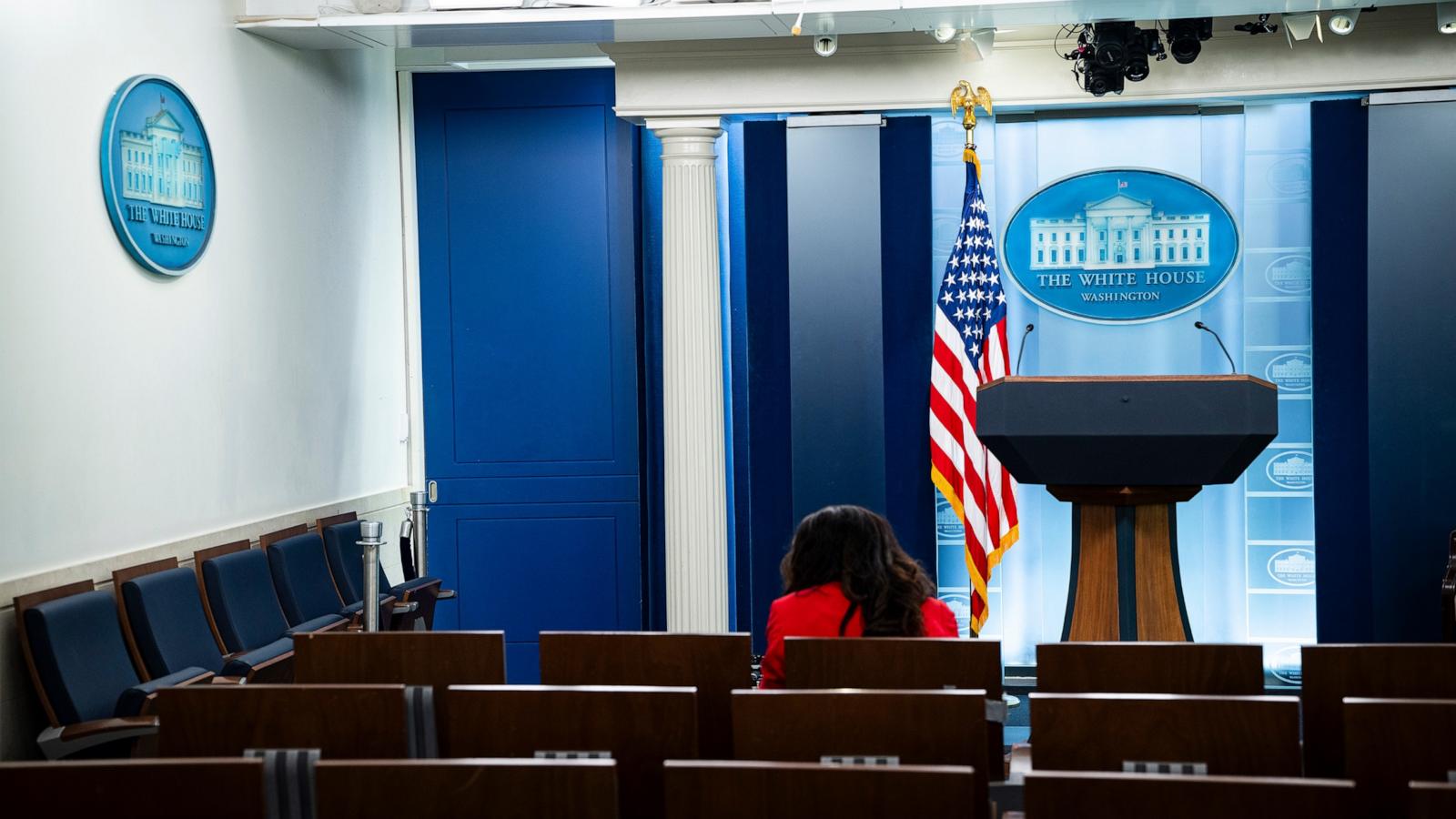
The three news outlets banned from the White House by President Donald Trump on Monday filed a First Amendment lawsuit to restore their access.
CNN, MS NOW and Politico are seeking a temporary restraining order demanding the White House restore their reporters’ credentials after Trump announced the ban on Friday.
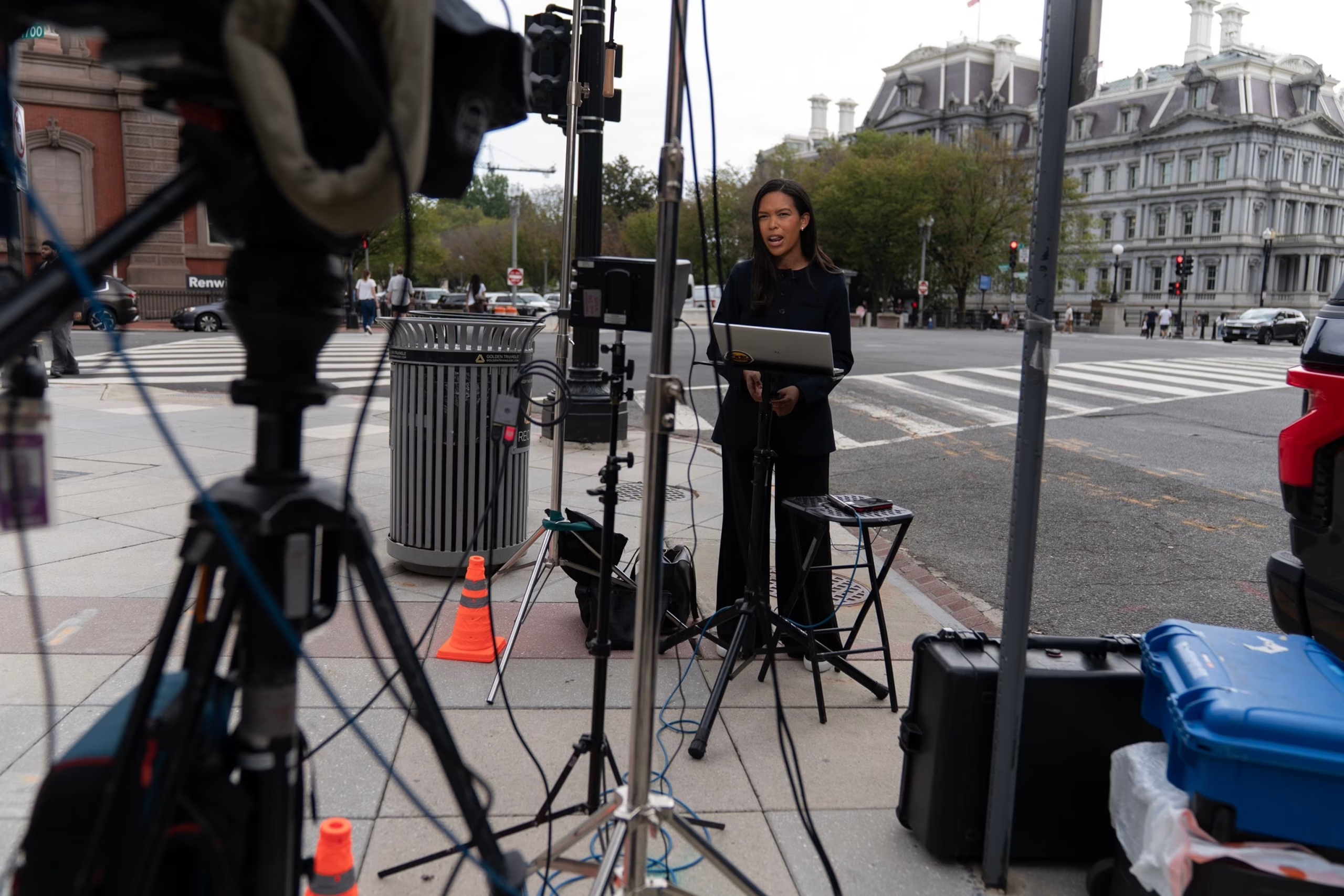
MS NOW White House reporter Akayla Gardner works near the White House complex after being denied entry following President Donald Trump’s ban on CNN, MS NOW and Politico, Sunday, Sept. 20, 2026, in Washington.
Jose Luis Magana/AP Photo
In a joint statement on Monday, the three news outlets said the lawsuit aims to “protect our First Amendment rights and defend the principle that the government does not decide what the press reports or publishes.”
“Without notice or process, the White House revoked our journalists’ credentials because it objected to our reporting. Left unchallenged, this threatens press freedom and the public’s right to independent journalism free from government interference,” the statement said.
Trump said in a social media post following the news on Monday that the barring of journalists was not “an assault on the Free Press” but instead “an assault on the FAKE NEWS,” which he claimed was a national security “threat.”
Trump said in a post to social media on Friday, “Media Outlets shouldn’t be able to constantly write or report FICTION and LIES when they’re covering the President of the United States, the Trump Administration, or the United States of America.”
At an event in the Oval Office shortly after he posted his message, the president suggested there may be more restrictions on other outlets. Trump told reporters he supports a free press, but that “you need a fair and honest press.”
“It’s sick. I mean, there’s something wrong with a country that can allow people to write purposely negative stuff. Now, if they want to write them, that’s fine. But I don’t have to let them into my, into the people’s house,” Trump said.
Journalists from the three outlets were turned away from the White House over the weekend. A reporter from CNN said on air that she was told by a Secret Service agent that her badge had been deactivated.
The three outlets are challenging the legality of the president’s ban on multiple fronts, according to the lawsuit.
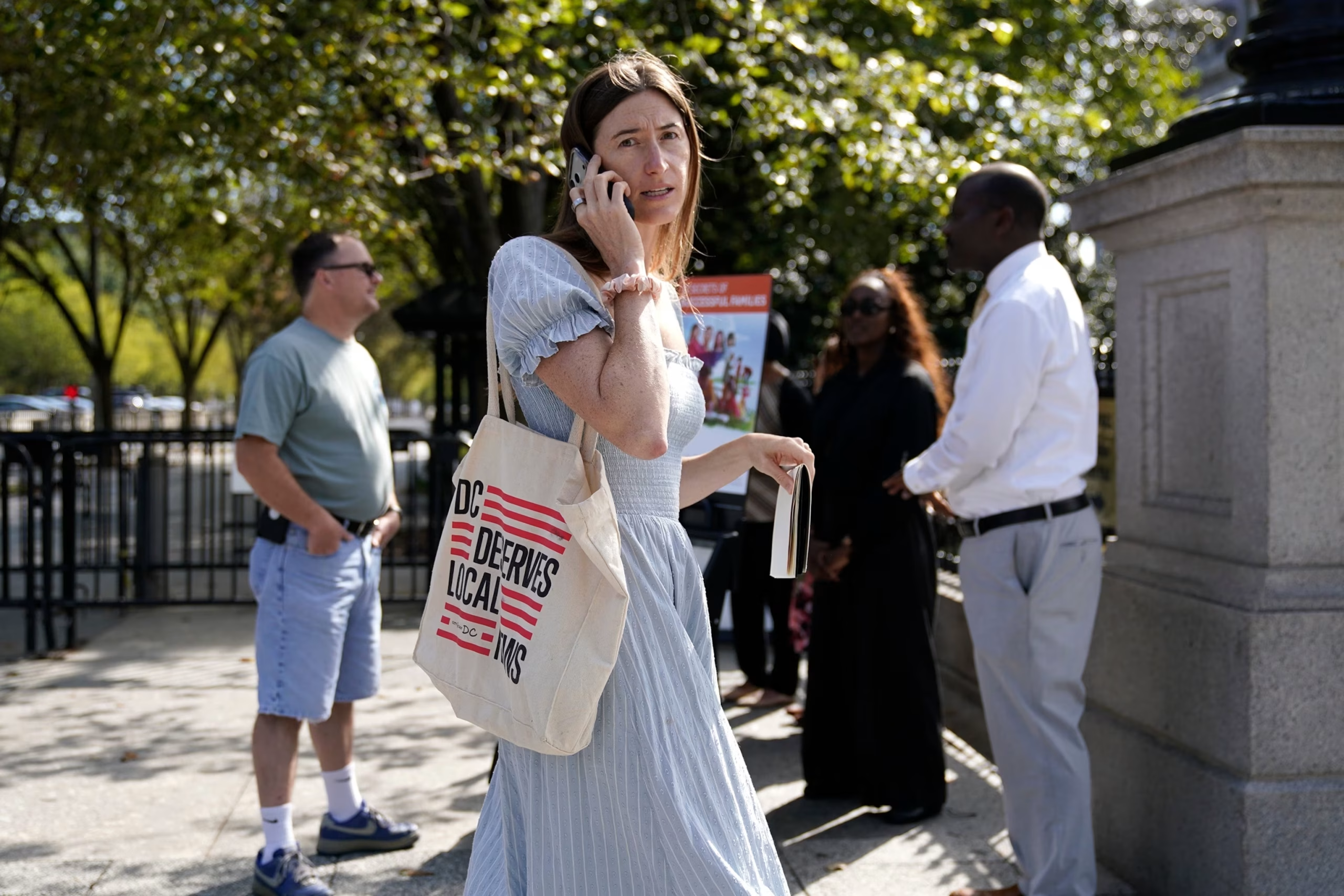
Politico White House reporter Cheyenne Haslett is pictured near the White House complex after having her credential revoked following President Donald Trump’s ban on CNN, MS NOW and Politico, Saturday, Sept. 19, 2026, in Washington.
Jose Luis Magana/AP Photo
The lawsuit argues the ban violates the outlets’ reporters’ due process rights, that it unlawfully retaliates against their protected speech and that it violates the First Amendment by barring them from a nonpublic forum for unlawful reasons.
“This ban could not be a more direct assault on the First Amendment nor a more blatant violation of our most fundamental constitutional principles,” the news outlets wrote.
The lawsuit warns of a cascading effect for other news organizations should Trump seek to expand the scope of the ban, as he said he may do in his Friday remarks in the Oval Office.
“The ban is already severely impeding the ability of CNN, MS NOW, and POLITICO to cover the President and his administration,” according to the lawsuit. “Every day, critically important news is breaking at the White House and in the press pool: President Trump is the commander in chief of a country at war; he is traveling to New York today to address the United Nations General Assembly tomorrow; he is meeting with China’s President Xi Jinping at the White House on Thursday; and he is steering national policy on the ever-advancing technology of artificial intelligence. And the ban inflicts an injury on all news media organizations—who now risk a similar fate if they engage in reporting the President deems insufficiently favorable.”
Popular Reads
The five members of the White House TV pool — ABC News, NBC News, CBS News, Fox News Media and CNN — issued a statement on the matter on Monday, saying “The public has a vital interest in receiving accurate, independent information about its government. No administration should restrict a news organization because it objects to its reporting.”
Vice President JD Vance on Monday pushed back on the notion that Trump’s actions constituted a ban, saying that the White House would not provide “special access” to outlets it deems are spreading “propaganda” against the president and his agenda.
“He’s not banning media outlets. What he’s doing is saying we’re not going to give you special access to the White House if you engage in what is effectively propaganda,” Vance said.
Trump’s initial social media post said he was “banning” the news outlets.
Vance was pressed by pool reporters traveling to with him on how this is not an attack on the First Amendment. Vance said the outlets are still able to report on the White House — it’s just that they won’t be able to maintain what he called “special access” to the building.
“Well, they can still report on the Trump White House. They can still get the public reports. They can still, of course, talk to people in the administration and outside the administration. What the president has said is, ‘we’re not going to give you special access inside the White House,'” Vance said.
The civil case has been assigned to D.C. District judge Timothy Kelly, who in 2018 oversaw former CNN correspondent Jim Acosta’s lawsuit that similarly sought to restore his press pass.
At the time, Judge Kelly, a Trump appointee, ruled in Acosta’s favor after finding that the Trump White House did not afford him proper due process in revoking his credentials.
The full D.C. Circuit and the Supreme Court have yet to establish settled precedent in the wake of Trump’s earlier attempted ban on The Associated Press from being part of the press pool and attending certain White House events last year.
While a D.C. District court judge backed the AP, a three-judge panel with the D.C. Circuit put the ruling on hold and later wrote that “restricted presidential spaces are not First Amendment fora opened for private speech and discussion.”
Monday’s lawsuit is expected to cite a 1977 ruling in which the full D.C. Circuit found that the White House cannot arbitrarily deny a journalist a press pass without due process.
“As the D.C. Circuit has long held, the interest that members of the press have in their White House hard passes is ‘protected by the first amendment’ and ‘undoubtedly qualifies as liberty which may not be denied without due process of law under the fifth amendment,'” the attorneys wrote, according to the court papers shared by Politico.
ABC News’ Fritz Farrow and Hannah Demissie contributed to this report.