This is the July 22, 2026, edition of “The Tea, Spilled by Morning Joe” newsletter. Subscribe here to get it delivered straight to your inbox every Monday through Friday.
There’s a traditional notion in Washington that a president’s second term tilts toward foreign policy in an attempt to solidify a global legacy.
That’s proven true for President Donald Trump as well, despite his “America First” agenda. The war in Ukraine, global tariffs, battles with NATO allies, regime change in Venezuela, the ongoing war with Iran — all of it has dominated the Trump administration’s focus since he returned to office last year.
Trump voters chose a candidate who promised to keep America out of foreign wars, and specifically warned that his opponent would attack Iran. He assured his supporters that domestic concerns would come first.
But look at what’s happened.
He threatened Greenland, Canada, and Cuba.
U.S. troops invaded Venezuela and bombed Iran on his orders.
Trump insulted NATO, attacked the prime ministers of Italy and Spain, and raised tariffs on our closest friends— all while pulling troops out of Germany and warning he would take them from Poland.
So much for America First.
Eighteen months into Trump’s second term, we invited three foreign policy experts to join us on “Morning Joe” to discuss the president’s legacy and where he might take America in the years ahead.
Richard Haass, president emeritus of the Council on Foreign Relations:
“Almost two years into Trump’s second term globally, I would define his foreign policy as a kind of aggressive unilateralism.
“Traditionally, the United States has pursued what I would call an imperial foreign policy — promoting a rules-based order, building alliances, maintaining stability. Under Trump, it’s become something closer to an imperialist foreign policy. He’s not looking to uphold an order; he’s looking to acquire things — whether it’s access to energy resources in Venezuela or new pieces of real estate in Greenland and Canada.
“And there’s simply no way to make sense of Iran except to say that the president and those around him got it dead wrong. And now he’s caught, and he’s flailing because he’s not sure whether to double down or to back out.”
Kim Ghattas, contributing editor at the Financial Times:
“The Americans, the Israelis, and the Iranians are all overreaching at this moment in the conflict. In an interview this weekend, the Iranian foreign minister, Abbas Araghchi, sounded almost demoralized.
“In Lebanon, meanwhile, there’s a real sense of being trapped between Israeli and Iranian fire. The Iranians are using Lebanon as a battleground to fight their wars against America and Israel while the Israelis are establishing this depopulated, uninhabitable buffer zone in southern Lebanon.
“But there’s also a lot of anger at Iran, and I would not discount that as a significant factor in how things unfold going forward.”
David Ignatius, columnist and associate editor at The Washington Post:
“The United States is stuck at this moment, but so is Iran. The problem is that the people who have the guns in Iran are too intoxicated with their resistance to the United States and Israel. And you can understand why. They’ve stood up to bombardment, and they’re still fighting. But Iran is actually playing a pretty weak hand, and week by week, their ability to project power declines.
“The biggest mistake that President Trump could make right now would be to deepen American involvement on the ground. I suspect that’s precisely the thing that the Iranians would like to see us do.
“The time has come to reach out to Europe and Asia, our allies, with a simple question: What are you prepared to do to help the United States reopen the Strait of Hormuz? Part of what really has troubled me about this war is that the United States has been acting alone, other than Israel, in combating Iran — which is a menace to the region. That shouldn’t be.”
MEASLES CASES HIT A 35-YEAR HIGH
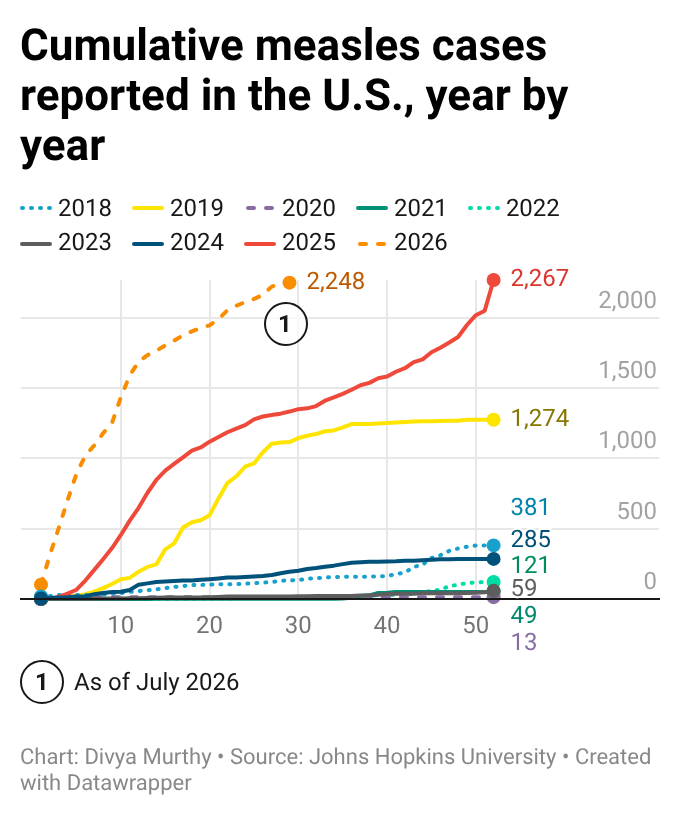
It’s only July, and the United States has already reported more measles cases than any year since 1991, The Washington Post reports — more than 90% of them in unvaccinated people. While the surge predates Trump, his public health cuts and Robert F. Kennedy Jr.’s vaccine skepticism certainly aren’t helping.

WAR BY ANY OTHER NAME
By Nancy A. Youssef and Jonathan Lemire
The Trump administration is back at war. It just doesn’t want to admit it.
In the 11 days since the United States resumed its airstrikes against Iran, neither President Trump nor any other senior administration official has publicly addressed the campaign. U.S. forces began by striking Iranian military facilities but later expanded to attacking civilian infrastructure that the administration says is being used for military purposes. As of today, congressional officials had yet to receive classified briefings on the latest phase of the war, aides told us.
The Pentagon, whose leadership stepped in front of the cameras in the weeks following the start of the war, in late February, hasn’t held a press briefing since May to answer even basic questions: Why is a resumption of the war necessary? What are the strategic objectives, and how have they changed? How many casualties have American forces suffered? What would define success?
STEVE RATTNER TALKS: BUDGET DEFICIT AND MANUFACTURING
When Trump returned to the White House in 2025, the deficit was $1.8 trillion — modestly lower than the year before. Now, even after adjusting for inflation, it has climbed to $1.9 trillion and is projected to hold there for a few years until rising steadily to $2.5 trillion in 2036. As a share of gross domestic product, the gap is projected to hover at or above 6%, compared with 3.4% in 2017.
How did this happen? Mostly via the One Big Beautiful Bill, which extended many of the tax cuts from Trump’s first term.

On another front, Trump’s vow to bring back manufacturing jobs and boost factory construction has also not unfolded as promised. The number of manufacturing jobs has dropped by 75,000 since Trump took office. Some of that reflects a trend that began in early 2023 — but Trump’s tariffs made it worse, raising the cost of key inputs like steel and aluminum and forcing U.S. manufacturers to cut back.
Factory construction tells a similar story. The dollar value has dropped to an estimated $175 billion on an annualized basis as of May, down from $250 billion in November 2024. Tariffs and sharp cuts to clean energy subsidies played a significant role, as did the fading effects of the CHIPS Act, which had fueled a wave of semiconductor plant construction. Trump likes to cite the surge in data center construction, but his policies had little, if anything, to do with it — and the increase doesn’t come close to offsetting the drop in new manufacturing facilities.

ONE MORE SHOT

Demonstrators march in Bengaluru, India, on Tuesday amid nationwide protests over an exam-cheating scandal linked to about a dozen student suicides. The unrest has posed one of the biggest challenges to Prime Minister Narendra Modi’s government since his re-election.
The post A look at Trump 2.0’s foreign policy record appeared first on MS NOW.