Most national headlines about Tuesday’s contentious GOP primary in Kentucky’s 4th Congressional District frame it as a contest between seven-term incumbent Rep. Thomas Massie and President Donald Trump, who is backing former Navy SEAL Ed Gallrein. The clash has become the most expensive congressional primary in history — but not just because of tension between the incumbent and the president. Campaign ads with artificial intelligence deepfakes and anti-LGBTQ+ and antisemitic attacks have dominated the race.
According to AdImpact Politics, which tracks spending on political ads across the country, the ad spend in the race has exceeded $32 million, the highest on record. Gallrein’s campaign spent a total $10.9 million in ads, and Massie, $7.6 million; political action committee ads attacking Massie are estimated at $7.9 million, and ads attacking Gallrein total $6.2 million.
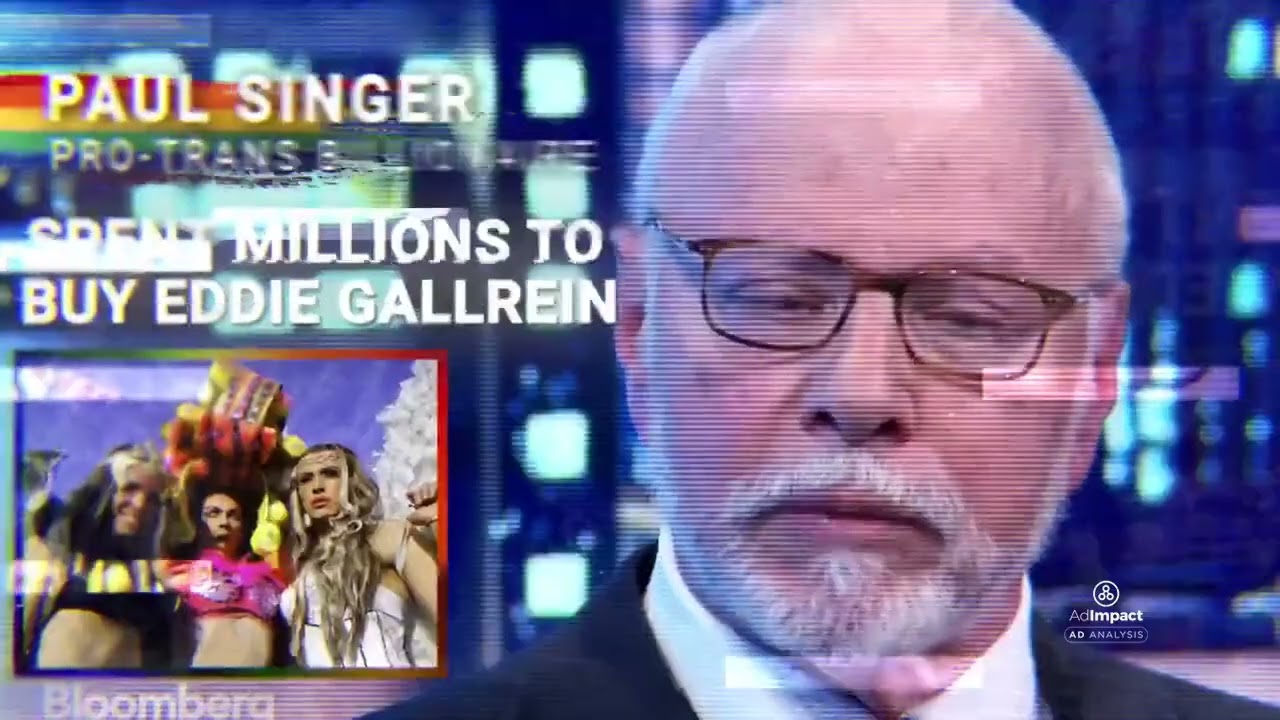
A week ahead of the election, Hold the Line, a pro-Massie PAC focused on “election integrity,” aired an attack ad against Gallrein that said, “The gay mafia will own Eddie.”
The ad zeroed in on Paul Singer, a prominent Jewish Republican donor, and played clips of his interviews with the rainbow Pride colors overlaying a Star of David. The ad said Singer would “bring his trans madness to Kentucky” and called him a “pro-gay, pro-trans activist working with far-left, hardcore Democrats.” Singer has previously said he gives to pro-LGBTQ+ causes in support of his son, who is gay. The commercial repeatedly calls LGBTQ+ people “weirdos” and “freaks” and says supporting Gallrein would “go against Kentucky’s values.”
Chris Hartman, executive director of Kentucky’s Fairness Campaign, an LGBTQ+ rights organization, called the ad “repugnant” and said that “offensive anti-trans cards have never worked.”
“Any marginalized community is at risk of becoming a pawn, and here we have it,” he said. “It’s Kentucky, and our community is suffering. We’re the ones being fed the spaghetti they’re throwing at the wall, 24 hours a day, whether we’re watching TV or YouTube.”
Fake AI attack ads have proliferated in political races across the country. In the GOP primary for lieutenant governor of Georgia, state Sen. Greg Dolezal posted a campaign advertisement that appeared to be an AI-generated video calling Muslims “Islamic extremists” and depicting what would happen if Georgia was “taken over by Sharia law.”
Fake AI attack ads have proliferated in political races across the country.
Back in the 4th District, an AI-generated campaign ad funded by the pro-Gallrein MAGA KY PAC reads “Massie caught in a throuple!” with fake surveillance footage of congressional Democratic Reps. Ilhan Omar and Alexandria Ocasio-Cortez checking into a hotel room with Massie. The ad accuses Massie of conspiring with the Democrats by voting against Trump’s tax cuts in the Big Beautiful Bill and the hiring of new border agents. “Worse than adultery. It’s a complete and total betrayal of Trump,” the ad reads. At the end, the ad states, “This satirical ad was created with artificial intelligence.”
Stephen Voss, a political scientist at the University of Kentucky, said the amount of spending on both sides is “remarkable” given the district’s geography. The 4th District is largely suburban and exurban, with a mix of rural and small-town territory and just one city, Covington. Its boundaries run from the outskirts of Louisville past the Kentucky “bump” (the suburban territory south of Cincinnati) all the way east to the edges of the Appalachian Mountains and the Cumberland ridge.
“If you have a district that’s centered in a city,” Voss said, “then you can focus on that city’s media market and you reach almost everybody and you don’t reach a lot of irrelevant people.
“So, media market-wise, where are you going to go? Louisville. Well, you can do that, but the majority of people you’re reaching can’t vote in the district. Cincinnati, you’re advertising half to Ohio. That adds to the expense of conducting a campaign,” he said.

Voss, who makes regular guest appearances on a Lexington radio station, said he has been hearing ads on the race in a district Massie isn’t even running in. The overlapping media markets, Voss said, might explain why one-off ads that can be posted on the internet and reach virality may be seeing some currency. “You can target using the internet a little more precisely than you can target using the airwaves,” he said.
Voss pushed back on the idea of the race as a referendum on Trump, pointing out that Massie has been the target of pro-Israel groups for two elections now. The race, he said, is about “ideological purity versus party loyalty.”
“His foreign policy preferences have put Massie at odds with the mainstream of the Republican Party for years,” Voss said. “I really view Trump’s opposition as the catalyst for releasing a pent-up desire to take down Massie that already existed.”
Gallrein has received millions of dollars in support from pro-Israel PACs.
Massie has a record of criticising the Israeli government’s actions and voting against the funding it receives from the U.S. In 2021, he was the only House Republican that voted against a bill providing $1 billion in funding to Israel’s war defense system, the Iron Dome. And in 2023, he joined 18 House Democrats to vote against a resolution that “recognized the 61st anniversary of the independence of the State of Israel.”
Gallrein has received millions of dollars in support from pro-Israel PACs like AIPAC, which have run ads touting Trump’s endorsement of him. In turn, last week, Massie announced he had introduced the AIPAC Act, or Americans Insist on Political Agent Clarity Act. The act would amend the 1938 Foreign Agents Registration Act and require groups working on behalf of other countries to influence government policy to report to the U.S. Department of Justice.
In this fight of party vs. ideology, then, it’s worth remembering that the 4th district has a fair number of ideological conservatives that favored Trump’s message of “America First.” That platform – not spending huge amounts of money on foreign interventions, including the Iran war – more closely matches Massie’s record. And it could cause Trump supporters, who expected the president to take the stances Massie did, to take a second look at their ballots.
The post The hateful ads pervading Thomas Massie’s reelection race appeared first on MS NOW.