In many ways, Jordan Willow Evans is your typical conservative Republican. She values small government and wants lower taxes. She agrees with President Donald Trump on some issues and breaks with him on others.
But in recent years Evans, who made history as the country’s first openly transgender Republican elected official, has found her relationship with the GOP strained, as the party she supported and campaigned for amid her transition has turned her identity into a political lightning rod. The same goes for her affiliation with the wider conservative LGBT movement, which began to distance itself from the trans community just as it found unprecedented influence in Trump’s Washington.
“I’ve only lived so much life, but most of that adult life was spent as a Republican trying to push what I was always told were Republican principles,” Evans told MS NOW. “And now, still believing all those principles, I find myself at odds with a lot of people I thought I understood.”
The wider conservative LGBT movement enmeshed itself with MAGA during Trump’s first term, even as his administration increasingly demonized the transgender community. That relationship began to ostracize people like Evans, who said she faced harassment from her fellow LGBT conservatives.
Her situation is reflective of a larger schism within the niche coalition, one that threatens its original goal: turning the GOP into a “big tent” party welcoming of all, regardless of sexual orientation or gender identity.
Although trans Republicans may be rare — only 10% of openly transgender individuals are aligned with the GOP, according to recent polling — they have long been a fixture of the LGBT coalition within the party. However, some gay, lesbian and bisexual conservatives today, especially younger Republicans who came of age in the Trump era, don’t believe they should share a cause with trans people.
“I am certainly more concerned with the ‘LGB’ than the ‘T,’” Zak Asplin, an undergraduate student at Bowdoin College, told MS NOW. “The first three are about your sexual preferences. The fourth one is distinctly about who you are and your conception of your own gender. That, I think, is an actual pedagogical difference which should be separated out.”

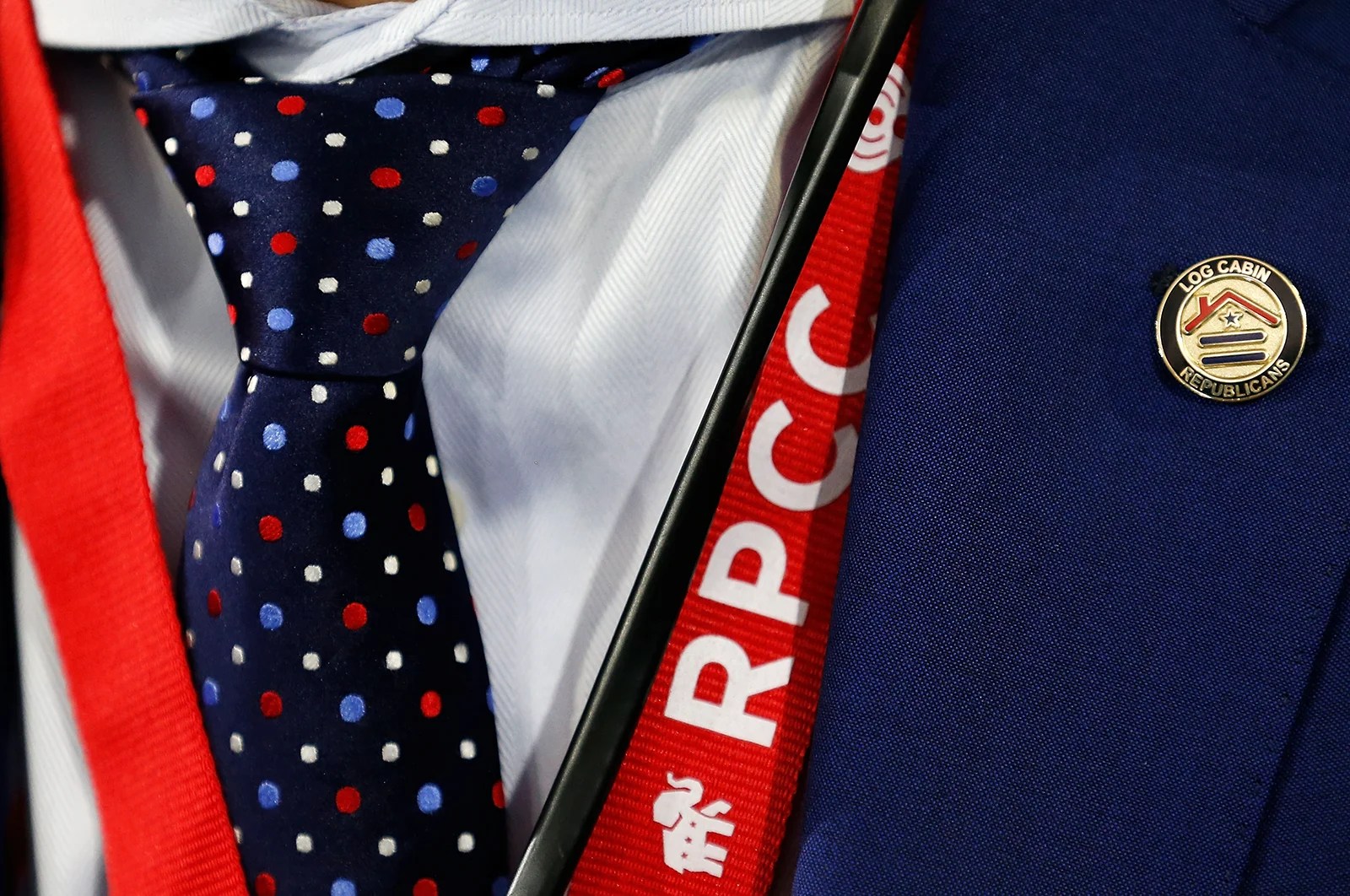
Asplin, who spent the better part of last year chairing the Maine College Republicans, is not actually a registered Republican. He is not even an American citizen; he has a thick British accent and a passport from the United Kingdom. But he is an outspoken member of the Log Cabin Republicans, the largest advocacy group for LGBT conservatives in the U.S.
While the organization may not put “QIA+” at the end of its acronym, it has historically made a point to include the “T.” Its issues page states that the Log Cabin Republicans support workplace protections “on the basis of sexual orientation or gender identity” and the “international decriminalization of gender identity/expression for trans people.”
But now, as the Trump administration ramps up its attacks against the trans community — most recently, on July 11, the president announced that Medicaid would no longer fund gender-affirming care for youths — the organization has turned toward party lines and away from its inclusivity principles.
The Log Cabin Republicans of Texas supported Gov. Greg Abbott’s restrictions on gender-affirming care for transgender youths in 2022, but maintained adults’ right to transition. That same year, members of the San Antonio chapter joined in an armed protest of a drag event, where the Washington Blade reported that demonstrators shouted homophobic and transphobic slurs at patrons and accused them of “grooming” children — a baseless line of attack used against the trans community, commonly among right-wing politicians and pundits.
“I could see how the Log Cabin Republicans certainly embody or try to keep the ‘T’ or aspects of the ‘T’ in their mission statement,” Asplin said. “I myself don’t feel the same way, and I think probably a lot of younger Republicans don’t.”
Asplin is 21 years old — the last time there was a presidential election without Trump on the ballot, he was in second grade (or Year 3, as they call it across the pond). It’s unclear how widespread his views are within Log Cabin — the current leadership of the organization did not respond to multiple requests for comment for this story — but Asplin’s Republicanism is a Republicanism of the MAGA era, and MAGA has placed a particular focus on rolling back rights and protections for transgender people.
Neil J. Young, a historian and author specializing in the gay conservative movement, told MS NOW that the Trump era has forced Log Cabin to “thread the needle a bit” when it comes to supporting transgender rights.
Evans says Log Cabin leadership invited her to join the organization in 2016. It was the year of Trump and a turning point for LGBT conservatives — Peter Boykin, a political organizer from North Carolina, had founded Gays for Trump. Boykin was an independent, but he was a fan of Trump; he had even participated in a local television station’s rendition of “The Apprentice.”
When Trump rode down the escalator to announce his campaign in 2015, Boykin registered as a Republican and founded his group. Gays for Trump earned attention from the likes of Roger Stone and Ann Coulter during the 2016 Republican National Convention (neo-Nazi Richard Spencer also reportedly attended the group’s party) and Boykin felt at home in the Trump coalition. At events like the Conservative Political Action Conference, Evans felt similarly welcomed.
“The sweetest old lady walks up to us and she’s like, ‘Honey, I don’t care what you are. I’m just glad you’re here.’ And we gave a hug. I think that really captured those first few years at CPAC,” Evans said. “But that last year, I ran into a lot of people who gave us grief. It was a very different experience.”
In 2019, both Evans and Boykin say, they were pressured out of Log Cabin. They both joined under the leadership of Gregory Angelo, but when its next leader, Charles Moran, took over, Boykin said the organization underwent a shakeup that forced him out.
Evans left voluntarily after Log Cabin endorsed Trump for the 2020 election. The organization had declined to endorse Trump in 2016, but under Moran, it appeared to more openly embrace the MAGA elements of its membership. It marked a stark shift away from the Log Cabin that was once eager to ruffle feathers on both sides of the aisle.

Log Cabin Republicans was initially founded as a loosely connected network of local California social clubs in the late 1970s, before emerging as a national political organization in the early 1990s under the leadership of its founding executive director, Rich Tafel.
The group’s initial goals were simple — combat the AIDS epidemic, repeal “don’t ask, don’t tell,” enact discrimination protections on the basis of gender identity and sexual orientation, legalize same-sex marriage and push the Republican party platform to include support for LGBT rights. At the time, it was a list that did not look too dissimilar from those of liberal-leaning organizations like ACT UP and the Human Rights Campaign.
“I always said our role was to call balls and strikes, which meant if the Republicans were bad, I would challenge them,” Tafel told MS NOW. “I was never popular within the Republican Party.”
Tafel faced a tough road to acceptance within the party. In the 1990s, he said, it was still a “big deal” for any Republican to accept money from Log Cabin. Sen. Bob Dole even returned a $1,000 check from the organization during his 1996 presidential campaign.
There were many gay men and lesbians in the Republican Party back then, but only two openly gay GOP lawmakers, former Reps. Steve Gunderson of Wisconsin and Jim Kolbe of Arizona, had ever seen re-election to Congress by the time George W. Bush left office. Years later, Ken Mehlman, Bush’s 2004 campaign manager and a former chairman of the Republican National Committee, would come out as gay in an interview with The Atlantic. The RNC was opposed to same-sex marriage under Mehlman’s leadership.
With persistence, Log Cabin made inroads within the party, eventually gaining a foothold among the staffs of moderate Republicans like former Massachusetts Gov. Bill Weld. They held up to 10 meetings a week on Capitol Hill with lawmakers, as Log Cabin members compared gay rights issues to guns and taxes — the “‘Leave Me Alone’ coalition,” Tafel called it.
The group’s efforts culminated in the revision of the RNC party platform in 2024, which stripped the document of language defining marriage as strictly between a man and a woman. Moran touted the achievement as “huge,” even though the platform still called on Republicans to “promote a culture that values the sanctity of marriage.”

Support for same-sex relations has waned among conservatives in recent years, from a high of 56% in 2022 to 35% this year, according to polling by Gallup. Concurrently, the Republican party siphoned off LGBTQ+ support — Trump earned 27% of the queer vote in 2020, but was unable to match even half that turnout four years later. Then-Sen. JD Vance had claimed that he and Trump would certainly win the “normal gay guy vote” in 2024.
“A slight majority of the Republicans supported same-sex marriage, and that was a huge accomplishment,” Young, the historian, told MS NOW. “But we’ve seen the real retrenchment on those numbers, the real reversal on those numbers, and I think they [gay conservatives] should be incredibly alarmed about it.”
Republican politicians have introduced resolutions denouncing same-sex marriage in at least nine states, according to Lambda Legal, an LGBTQ+ rights group. In June, Rep. Andy Ogles, a Tennessee Republican who recently lost his re-election primary bid, said “homosexuality has no place in America” in a post on X. Ogles deleted the post after a wave of bipartisan backlash and claimed a staffer had written it without his knowledge.
Gay conservatives are quick to point out that Trump was the first president to enter the White House supporting same-sex marriage. (Former President Barack Obama first backed it in his 2012 re-election campaign.) A gay man, Jacob Helberg, serves as an under secretary of state. Another, Richard Grenell, is Trump’s envoy for special missions abroad. The president also appointed the highest-ranking gay official in U.S. history, Treasury Secretary Scott Bessent.
In Trump’s Washington, Young said, there has been a “flourishing” of the gay conservative identity “in a sort of broader, much more public, much more visible way than was the case historically.”
Bessent, Helberg and Grenell, all married gay men, also serve as a safety blanket of sorts for many gay conservatives. At a time when some fear that Obergefell v. Hodges will be overturned, which Supreme Court Justice Clarence Thomas suggested in 2022, gay conservatives can easily dismiss those concerns by pointing to Bessent’s position in the administration.
“Gay rights are a settled issue, certainly within the conservative movement,” Asplin said. “I cannot possibly imagine this administration coming out and doing something blatantly homophobic when the Treasury secretary and one of the president’s closest confidants is a married gay man.”
Yet this year, the national Log Cabin organization endorsed a handful of Republicans who voted against the Respect for Marriage Act, the 2022 law that federally redefined marriage to include same-sex couples. Representatives Mario Diaz-Balart and Maria Elvira Salazar of Florida and Rep. Beth Van Duyne of Texas all voted against sending the legislation to President Joe Biden’s desk.
Others, including West Virginia Sen. Shelley Moore Capito, voted against pro-LGBTQ+ legislation like the Don’t Ask, Don’t Tell Repeal Act and the Employment Non-Discrimination Act. Those votes happened during her time in the House, and while she has supported some pieces of pro-LGBTQ+ legislation as a senator, she remains staunchly opposed to the expansion of transgender rights. Despite receiving the backing of Log Cabin, Moore does not include the organization on her list of endorsements.
With less than three months until Election Day, attack ads featuring anti-trans rhetoric have flooded the airwaves in battleground states like Texas, Ohio, Georgia and Iowa. In the latter, Log Cabin-backed Rep. Ashley Hinson, the GOP’s Senate candidate, accused her opponent, Democrat Josh Turek, of supporting “sex changes for kids.”
All of the ads echo Trump’s own language on the issue. He often rails against “transgender mutilization” during speeches and has used similar language for trans youth since 2023 — more than a year before the Log Cabin Republicans endorsed him for a second time. The group called the move its “highest level of cooperation” yet with the Republican Party.
Last year, Tafel, who has not been associated with Log Cabin since 2018, watched with dismay as the Trump administration halted PEPFAR, the U.S. government’s global initiative to combat HIV/AIDS. It was the initiative Tafel spent years pushing for during the Bush administration. In response, Log Cabin published an op-ed arguing that a review of the program was “long overdue.” An image of Trump still greets visitors on the Log Cabin website.
“You have to ask yourself: Am I doing this to be liked by them? And if you’re doing it to be liked by them, I mean by the party, you need to get into another business because that’s not the business that advocates are in,” Tafel said. “You can’t be in it to be liked.”
Both Evans and Boykin remain involved party members, despite their alienation from Log Cabin and the GOP writ large. Evans is a library official in Goffstown, New Hampshire — her fourth elected position — and Boykin now runs the “Gay Republicans for Liberty” Facebook group, a Gays for Trump successor that now boasts almost 17,000 members.
Although the group was founded on the principle that “political conservatism is not social conservatism,” Boykin says debates and schisms have ballooned within its ranks.
In June the national Log Cabin Republicans celebrated the Supreme Court’s decision to uphold bans on transgender women in sports. The statement again brought into question the organization’s commitment to discrimination protections on the basis of gender identity.
“We’re all playing a dangerous game right now,” Evans said. “Especially those who think that dissecting the community is going to help.”
The post Trump’s anti-trans crusade is tearing apart the conservative LGBT community appeared first on MS NOW.