

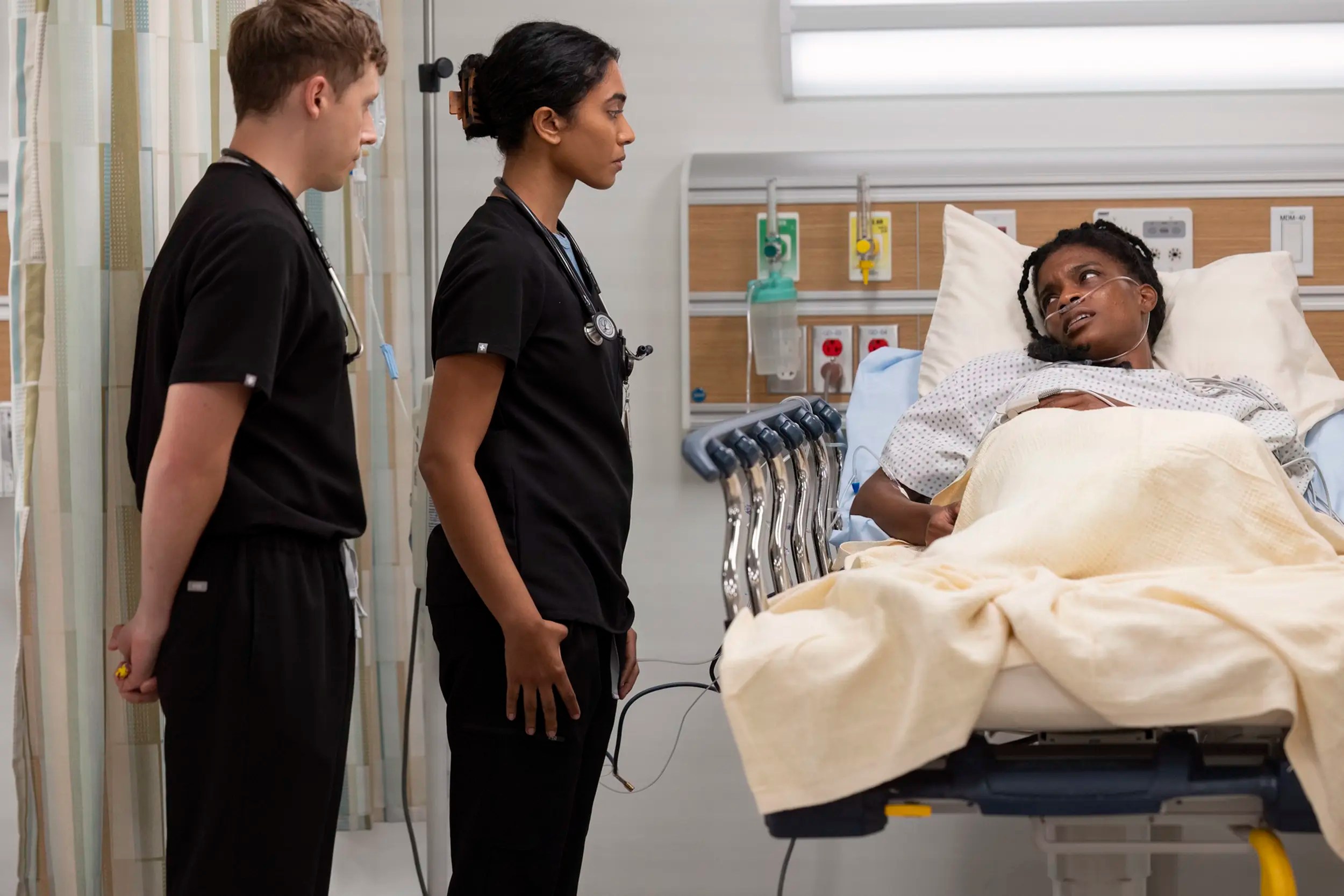
While watching episodes of “The Pitt,” the medical drama whose season two finale airs Thursday, I noticed a shift in how I related to my own medical trauma — particularly when it comes to conscious and unconscious biases of medical practitioners.
I remembered how in 2023, while traveling back from a vacation in Greece with my mother, my retina detached. I didn’t know what was happening at the time, except that part of my vision went black and the blackness was spreading by the hour. We had a layover in Switzerland, and I rushed to a doctor, who informed me of what was happening and booked me into the hospital the following morning — but not before she incredulously asked, “This is really your mother? But you’re so …,” and then she pointed at her skin. (I am biracial, and my mother is white.)
Over the past year, I’ve found solace in an unexpected source in watching “The Pitt.”
The next morning, the doctors at the hospital refused to perform surgery on me. They said they didn’t want to risk dealing with a patient who didn’t have Swiss medical insurance. Left untreated, I was at risk of losing my eyesight, and we begged the doctors to perform the surgery, offering to use money from our savings to pay up-front.
They told us no one in Switzerland would want to perform the surgery given the insurance issue, insisting our only option was to leave the country and get treatment elsewhere. Their refusal to treat me made no sense, especially after our offering to pay. Contradicting the first doctor’s instructions to keep my head back, they told me there was no need to be so vigilant and that I could move my head around and travel. We flew to England, where we have family.
When I finally saw a doctor in London, he was aghast that they had refused to perform the surgery, told me I could move my head around (which had caused significantly more damage) and sent me away. By that point, the macula had detached, and I was at an even higher risk for blindness or severe vision loss. I had lost valuable time, too — the longer one waits, the higher the risk of blindness, the doctor explained. He acted with urgency and ultimately saved my vision.
Later, the doctor told me he called a doctor friend of his in Switzerland to ask how this was possible and if it really was a matter of insurance. Something was not adding up.
“He said it seemed highly unlikely that an insurance issue would be legitimate grounds to deny emergency care,” my doctor said of the conversation with his friend. “He thinks it was most likely racism.”
All the doctors who treated me in Switzerland were white. The doctor in London was not.

Throughout much of my life, my experience with medical trauma, as a result of both chronic illness and acute medical emergencies, has been compounded by health care systems that severely disadvantage women and minorities. And I say this as someone with an extraordinary amount of privilege.
Over the past year, I’ve found solace in an unexpected source in watching “The Pitt,” a runaway hit series that has captured the attention of viewers for two seasons now. It has been a reparative experience, for one because most of the doctors and medical professionals in the show don’t carry the biases that have harmed so many of us in real life. And, maybe even more significantly, when they do exhibit bias, they are promptly held accountable by their colleagues.
All the doctors who treated me in Switzerland were white. The doctor in London was not.
In “The Pitt,” patient care is course corrected in a way I have never personally experienced. There is a sort of bias-based justice in the world of the show that does not exist in the real world, by most accounts.
This has been a throughline in both seasons. Take, for example, the storyline in the first season of patient Joyce St. Claire (Ashley Romans), a Black woman who is brought into the ER screaming and writhing in pain. The paramedics immediately dismiss her as they hand her off to Dr. Sapira Mohan (Supriya Ganesh): “Drug-seeking woman kicked off the city bus for disrupting and disturbing passengers,” one of them says (even though she was the one who called 911). The paramedics, both of whom are white, attempt to restrain St. Claire as one of them yells, “Stop fighting! Calm the f— down or I’ll call the cops.”
Dr. Mohan attempts to intervene, before screaming, “Stop!” at the paramedics. After taking time to listen to the patient, she quickly ascertains St. Claire is suffering from acute pain as a result of her sickle cell disease and administers morphine and Dilaudid.

“I’m so sorry this happened; you’re going to be okay now,” Dr. Mohan reassures the patient. “You’re safe here, I promise.” Ultimately, the words anyone in medical distress yearns to hear in an ER setting.
When resident doctor Dennis Whitaker (Gerran Howell) later tells St. Claire “don’t go crazy” with the button that administers her pain medication, Dr. Mohan immediately pulls him aside and chastises him for dismissing her pain. And rather than becoming defensive, he is contrite.
Later in the series, Dr. Mohan explains to St. Claire and her wife that her father’s untimely death informed her decision to be a doctor: “He’s the reason why I got into medicine. And the reason why I’m conducting research into racial disparity in the ER. I’m doing a retrospective chart review on the past five years of patients of color.”
Characters who hold themselves and others to account in this particular regard often offer a relevant statistic; it’s a testament to the writers and actors that the inclusion of these stats feels organic rather than forced.
In Season Two, after a different Black woman comes in with a cough and is given a diagnosis of aspiration pneumonia, Dr. Mel King (Taylor Dearden) catches that it’s linked to the patient’s bulimia and sets her up with a recovery plan, which includes being paired with a Black female therapist, as per the patient’s request. When Dr. Trinity Santos (Isa Briones) commends Dr. King for catching the underlying cause, King responds, “Black women tend to go underdiagnosed when it comes to eating disorders.” (This is true, according to a range of studies, which also found Black women “are less likely than Whites to … receive a recommendation or referral for further evaluation of care for an eating disorder,” according to an article in Current Psychiatry Reports.)
Later in the season, when two male paramedics fail to adequately attach a 12-lead ECG to a patient because they are afraid of touching her breasts, the patient’s care team misses a massive heart attack. Dr. Michael “Robby” Robinavitch (Noah Wyle) upbraids them in front of the ER staff (in a manner that is admittedly unprofessional), angrily asserting, “Women are misdiagnosed for heart attacks all the time.” A study published by the Journal of the American Heart Association explains 18- to 55-year-old females who go to the ER with chest pain have a significantly longer wait time than men. The same study found that non-white patients also had to wait longer to be treated by a doctor than the white patients did.
One of the most moving storylines for me this season was that of a young woman, Ilana Miller (Tina Ivlev), who arrives at the ER after being date raped. She is treated with nothing but dignity and compassion by charge nurse Dana Evans (Katherine LaNasa) and trainee nurse Emma Nolan (Laëtitia Hollard), who respectively conduct and support the forensic examination associated with a rape kit. Viewers are shown just how invasive the process is. Evans and Nolan attempt to minimize the invasiveness of the procedure with the care they provide and, still, understandably, the patient almost decides to leave midway. Approximately 80% of people who are raped never report it, precisely because the process can be so retraumatizing.

I was date raped when I was 18 years old. I threw away my clothes afterward, cleaned the apartment with bleach and scrubbed myself until my skin was raw. I later learned that’s a common trauma response. That is all to say, I did not seek out a rape kit forensic exam.
Shortly after, I spoke with a psychiatrist, a cisgender, heterosexual white male, who strongly urged me not to press charges. He said I would have little credibility in a “he said, she said” case and/or trial (I identified as a woman at the time). The rapist was a cis-het male who went to an Ivy League school, and he would be believed, he said. Conversely, I would be painted as “a man-hating lesbian.” His delivery was cavalier.
While the rape kit scenes are hard to watch, the treatment that Miller receives on the show, like so many instances in the series, feels both corrective and reparative. I wonder how different the burden of this traumatic event would feel had I been met with a similar kind of compassion and support, had I been witnessed and validated rather than dismissed and belittled.
“The Pitt” has received a lot of praise for how medically accurate it is. It’s interesting, then, that the best part of the show, in my experience, is also its most unrealistic. Watching episodes and following the real-time storylines of patients and medical professionals feels reparative to someone like me, and likely so many others who have experienced medical trauma.
While it’s important to separate individuals from institutions and ideologies, the show is also an indictment of a system in which practitioners pledge to do no harm — but continues to inflict plenty of it.
The post ‘The Pitt’ is an indictment of doctors who pledge to do no harm — but continue to inflict it appeared first on MS NOW.

