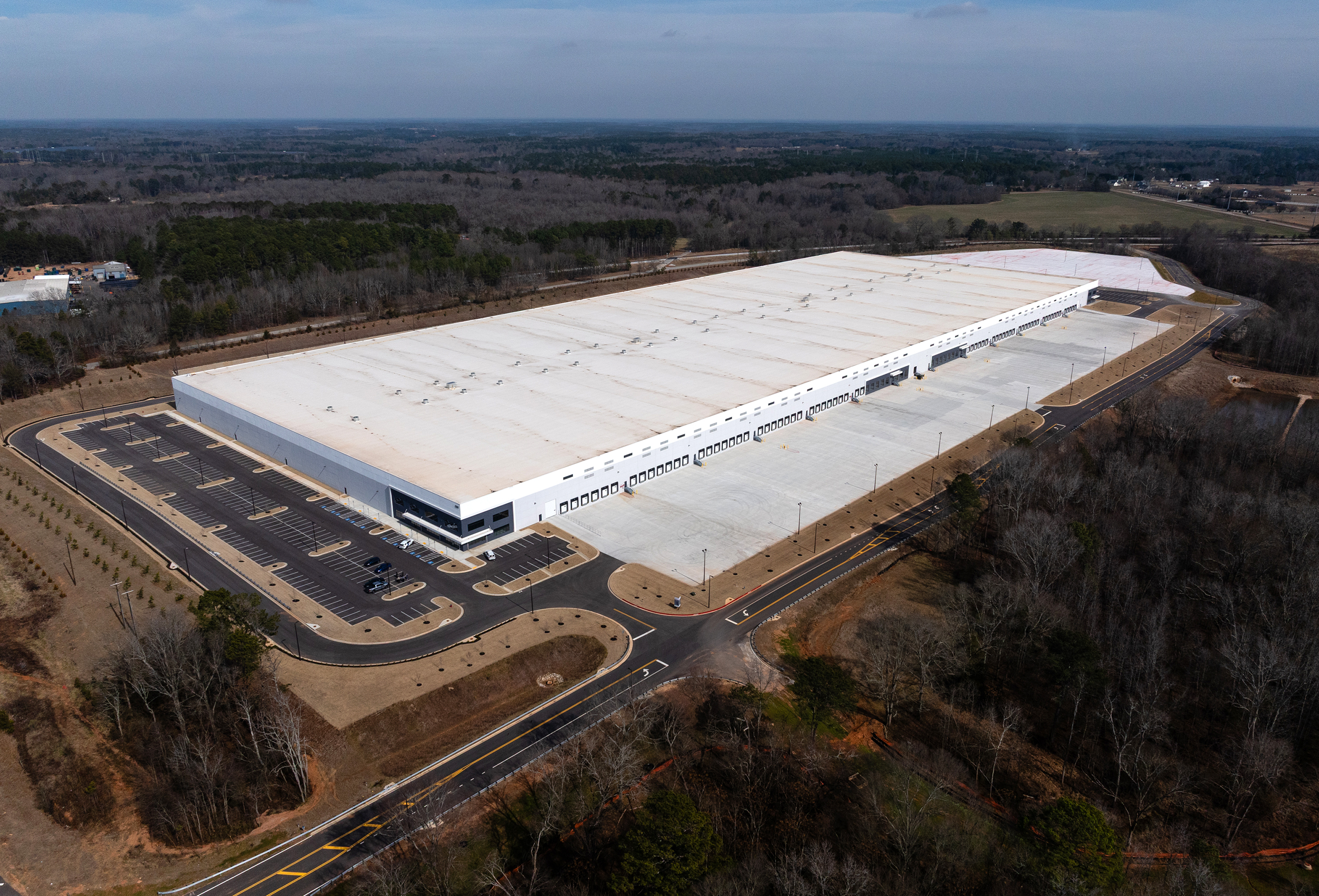
The most fundamental hurdle to the Department of Homeland Security’s plan to hold tens of thousands of immigration detainees in structures built as would-be retail distribution centers isn’t political.
It’s the plumbing.
Documents reviewed by MS NOW, along with interviews with city workers and elected officials, show that all 11 of the warehouses that DHS has purchased and wants to convert to detention facilities face critical challenges with water supply, wastewater processing or both.
Some of those issues will cost tens millions of dollars to fix, if they’re fixable at all: Public works infrastructure that services the warehouses DHS bought won’t be able to handle the strain from such a facility, MS NOW found, at least not without drastic expansions and updates that the communities can’t afford and that the government has so far not included in its public plans. Several can’t be made to accommodate them no matter what.
Warehousing detainees is the next phase of the DHS effort to make good on President Donald Trump’s campaign vow of mass deportations, with a $38.3 billion budget and a target capacity of 92,600 before December. To make it happen, the agency has hustled through purchases of existing buildings rather than build new ones or contract out all the additional beds to the private prison companies it already uses.
Newly minted Homeland Security Secretary Markwayne Mullin tapped the brakes on that plan as one of his first acts on the job, The Associated Press reported this month, citing a senior DHS official as saying the department would pause warehouse purchases and “scrutinize” the ones it’s already bought.
But the department has given no indication it is abandoning the warehouse model, especially not after having already spent nearly $1.1 billion buying them and another $426 million starting to prepare them.
“I don’t think the federal government is going to let those facilities sit empty,” said Aaron Reichlin-Melnick, senior fellow at the American Immigration Council. “How much they are able to convert them into detention centers or offices remains to be seen.”
If the plan moves ahead and contractors convert the warehouses to holding facilities, they’ll look and function a lot like what most would call very, very large jails. Except when governments and companies build jails, prisons or pretty much any other large structure, they’re required to assess the impact on the environment and local utilities.

It’s unclear how many of the warehouses have received such an evaluation — at least one hasn’t — because DHS has not released that information, often even to those in the communities. The department gave MS NOW a statement it has previously issued saying the warehouses “will be very well-structured detention facilities meeting our regular detention standards.”
So, local and state officials have had to make their own assessments about how a facility would affect their public works infrastructure.

- When the Pennsylvania Department of Environmental Protection ran the estimates on a proposed megacenter in the Appalachian community of Tremont Township, it found that the facility would use up to 90% of “all available stored water in the Tremont Water system,” every single day.
With just 7,500 detainees — the low end of its projected capacity — the center would produce up to a million gallons of waste a day, the state said, more than double what the treatment facility can handle. State environmental officials reached similar conclusions about a proposed processing facility in Upper Bern Township, not far away.
- In Oakwood, Georgia, city manager B.R. White told MS NOW that the warehouse DHS wants to convert into a processing facility cannot be hooked up to municipal sewage. The facility would “far exceed” the capacity limits Oakwood has with the city of Gainesville, where its wastewater is treated. Even if Gainesville agreed to raise Oakwood’s capacity, White estimates it would cost Oakwood an additional $12 million.
And the sewage wouldn’t even be able to get to the treatment facility without major overhauls to the pipes from the warehouse and the downstream infrastructure, White said.

- Robert McCraight, the mayor of Romulus, Michigan, told MS NOW the proposed processing facility there, near Detroit’s airport, would face similar sewage line issues. He said he got his start in city government as a building official, so he knows the work it takes to get a building hooked up to public utilities.When city workers went to the warehouse to give DHS information on connecting to public utilities, they found no one, so they taped the materials to the door. When the workers came back to follow up, they found their materials still taped there, along with a DHS flyer on the door inside titled “Federal Rules and Regulations for Conduct on Federal Property.”
McCraight also says — and flood zone maps from the Federal Emergency Management Agency confirm — that the warehouse is located in a flood zone and most recently flooded last year. The state has sued to block the facility.
- The megacenter outside El Paso, Texas, would demand so much water, it would likely require a 1 million- to 2 million-gallon water tank on the property, Lower Valley Water District general manager Gerald Grijalva said. That’s on top of replacing and rerouting sewage lines to handle the additional wastewater.
- City councilor Johnny Melton of Surprise, Arizona, confirmed that sewer upgrades would be required for their system to handle the influx of wastewater from a processing facility outside Phoenix.

- Maryland’s attorney general alleges in a lawsuit that sewage upgrades would be required for a planned processing facility in Williamsport, in the state’s panhandle on the West Virginia line. At a hearing last week in Baltimore, a judge issued an order barring any work besides basic interior repairs until DHS conducts an environmental impact study, which the agency agreed to do.

- New Jersey and the town of Roxbury are similarly taking DHS to court over the agency’s intention to put a processing center in the northern part of the state, a region from which 70% of New Jerseyans’ drinking water comes, the state and town allege in their lawsuit filed last month.
New Jersey’s Department of Environmental Protection says the facility — currently an empty warehouse with four toilets — would increase sewage and water demand far beyond the capacity of public utilities to treat or transport.
- The San Antonio Water System, which would have to service another planned processing facility, told MS NOW that if it exceeded the city’s water and sewer capacity, the city would require a new utility service agreement with DHS alongside any infrastructure upgrades.

- Homeland Security’s plan for a large facility in Salt Lake City will have to overcome a different water-related complication: drought. A city ordinance passed last month caps usage for new, nonresidential buildings at 200,000 gallons per day. That’s conservatively a quarter of what the facility would need to hold the planned 7,500-10,000 detainees; Mayor Erin Mendenhall says it could require five times that much or more.
Although the ordinance amendment is set to expire in September, city leaders are considering making it permanent.
Through all of these communities, whether tiny or metropolitan, a common theme is the apparent lack of proper planning for coping with the basics of abruptly putting thousands of people under one roof.
One of the few places where DHS has discussed such concerns in even rudimentary detail is Social Circle, Georgia, an hour east of Atlanta. The department gave officials there what appears to be a partial engineering assessment for a facility that could triple the town’s population of 5,000.

In that document and their lone conversation with town officials, DHS representatives suggested piping detainees’ sewage to a treatment facility in a neighboring county that isn’t connected to the town system, city manager Eric Taylor told MS NOW. And DHS wanted to draw drinking water from the town’s supply at a volume twice what the town is legally allowed to take from the Alcovy River, Taylor said.
When town officials pointed out those flaws, DHS floated trucking clean water in and wastewater out, as they do at the hastily constructed Everglades airstrip tent city that Florida officials dubbed “Alligator Alcatraz.”
“Assuming a tanker truck that hauls 6,000 gallons at a time, you’re looking at almost 167 trucks per day,” Taylor said. “Are you just going to have a constant parade of water and sewer vehicles driving up and down the bypass all day long, every hour of the day?”
If the truck scenario doesn’t work, DHS said, it could dig a massive cistern or dozens of wells on the property, which almost certainly would disturb the water sources for neighbors who also rely on wells.
“My overall impression is, is that they are not doing a thorough analysis about what it’s going to take to open these facilities, that it’s very rushed,” Taylor said.
Fallon Gallagher and Grace Cardinal contributed to this report.
___
This story is part of Cities Under Siege, an MS NOW effort to document how the Trump administration’s aggressive immigration enforcement tactics are impacting communities across America.
The post Plans to warehouse ICE detainees don’t address the plumbing problem appeared first on MS NOW.