

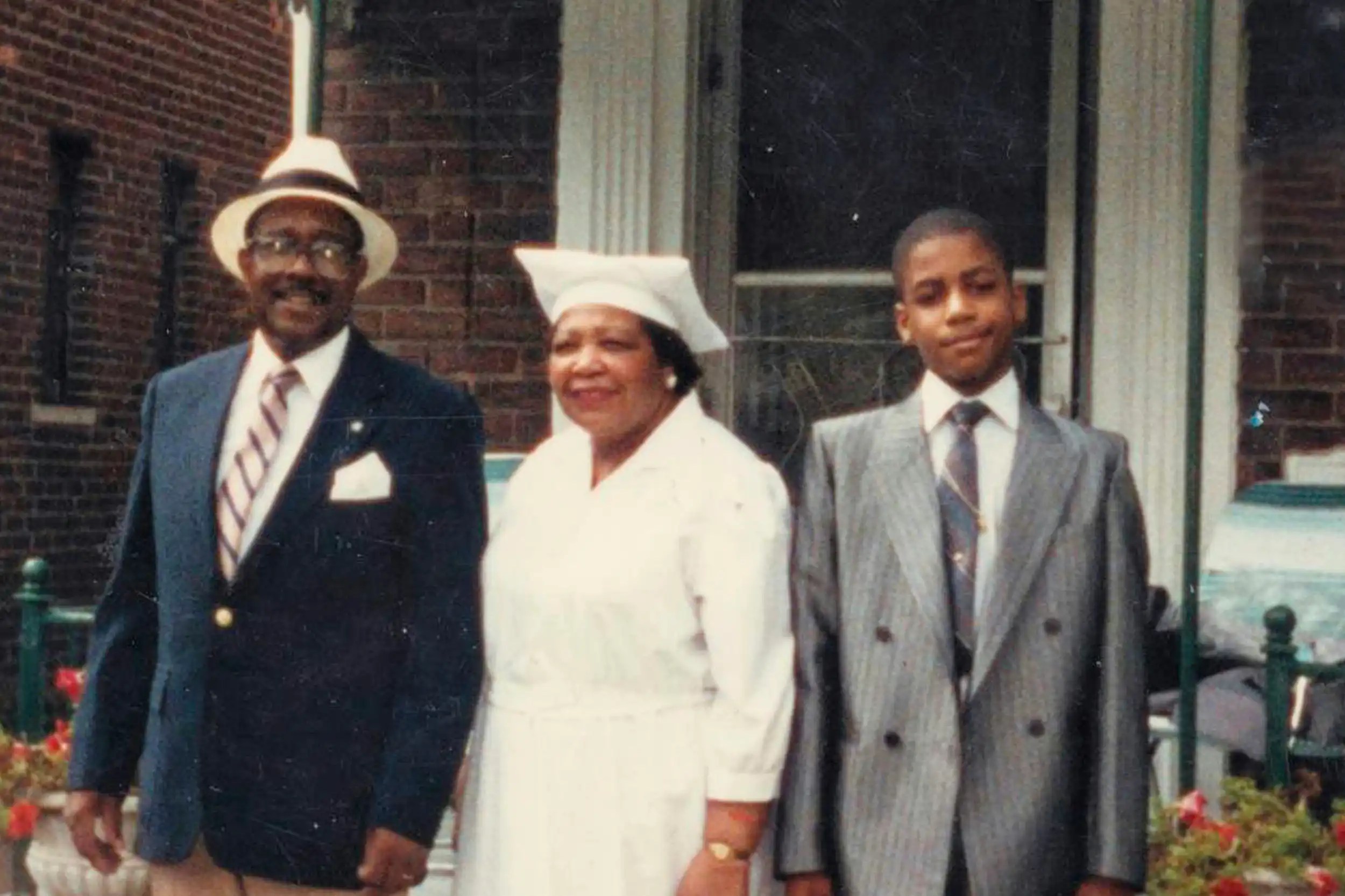
Nothing prepared me for the first time my young son asked me, “Dad, where are your parents?” There I was, stuck trying to negotiate with myself over how much truth I should tell. I had been answering the question about my parents’ absence most of my adult life, but my son was 8, and I didn’t think telling him that my father killed my mother and then himself when I was a baby was something he needed to hear. So I simply responded, “They passed away when I was young,” followed with “I’ll tell you about it when you get older.”
He said, “OK, Dad.” And I let out a sigh of relief knowing that I got off easy.
My son was 8, and I didn’t think telling him that my father killed my mother and then himself when I was a baby was something he needed to hear.
Those are the kinds of moments I thought about when I read the story out of Virginia last week. Police say former Virginia Lt. Gov. Justin Fairfax killed his wife and himself as they were going through a divorce. Police say that the couple’s teenage children were in the house at the time and that one, a son, called 911. Every story like that — and there have been many — reminds me of the story of my parents.
“The incidence of murder-suicide in the United States is higher than earlier estimates suggest,” Columbia University’s Mailman School of Public Health reported in August. Such crimes, the school reported, “are occurring more frequently than previously documented — particularly among current or former intimate partners.” Between 2016 and 2022, researchers counted 5,743 deaths in such crimes: 3,125 homicides and 2,618 suicides. Fifty-seven percent of the homicide victims were “current or former intimate partners of the perpetrator.”
In a suspected domestic violence homicide that did not include a suicide, Coral Springs, Florida, Vice Mayor Nancy Metayer Bowen, an expected congressional candidate, was found dead at her home on April 1. Police booked her husband, Stephen Bowen, on suspicion of her homicide.

Sunday in Shreveport, Louisiana, police say Shamar Elkins shot and seriously injured his wife and a woman believed to be his girlfriend and killed eight children, seven of them his. Elkins died after police chased him Sunday, and it was unclear Monday whether he was killed by police or whether he killed himself.
On Friday morning, Oct. 21, 1977, my mother, Wanda Davison, was found dead at age 29 in her bedroom from blunt force trauma to the head. Her pink nightgown had been pulled up and wrapped around her head under a blood-soaked pillow. There was a bloody rolling pin next to her and a tack hammer on the floor. The windows had been duct-taped shut, the stove’s pilots had been blown out, and the gas knobs had been dialed all the way up. I was found by the police crawling and crying on the bathroom floor and given to my maternal grandparents (who would go on to raise me). At the same house two days later, my 35-year-old father, Oscar Davison, the primary suspect, was found dead inside his car from a self-inflicted gunshot wound.
They had been married five years. I was 15 months old.

There were no cellphones in 1977, no social media and no 24-hour news cycle. Secrets were easier to keep and my grandparents kept the secret of what happened to my parents, apparently out of the hope that if they didn’t talk about the tragedy, then it might go away.
Just like I would eventually do with my son, my grandparents simply told me my parents had died. They never told me how. They forbade their social circles of church friends and extended family from discussing what had happened to my parents. They would quickly pivot the conversation if a teacher asked. They felt I was entitled to an upbringing free from disclaimers and low expectations — and they were right.
Eventually, the Fairfaxes’ two teenagers are going to have to re-enter the world. And from school to social activities, they’re going to find themselves constantly surrounded by people who know what happened. They’ll know why people are staring, and they’ll be able to identify the glaring sympathy behind the eyes of concerned friends and adults. Because sometimes, receiving love and support feels warm, but at other times it feels awkward; it’s a reminder that your identity has been replaced with that of a victim.
When I was growing up, my grandparents were extremely loyal to the Mother’s Day tradition of wearing a white carnation to honor one’s deceased mother, or a red one to celebrate a mother who was alive. Everywhere we went on that holiday, my white carnation and I were stared at. Even though I was a child, I knew what pity felt like — and I hated it. Till this day, as you might expect, I have a complicated relationship with Mother’s Day.
Even though I was a child, I knew what pity felt like — and I hated it.
I was a freshman in college when I decided to find out how my parents died. I searched every Detroit newspaper dated October 1977 on microfiche until I found the details of what happened to Oscar and Wanda Davison. (My grandmother had already died when I found out, and in the five years between my finding the newspaper stories and my grandfather’s death, I never revealed to him that I’d learned the truth.)
As strange as it may sound, initially the revelation provided relief, because I finally knew, but it became perplexing as I started to embrace young adulthood. Now I was carrying something that would alter the way I was viewed when I told people. Some love interests saw it as a red flag, and others wanted to trauma-bond. By my early 20s I had started talking about it, I recited poems about it, and I used it as a bridge to mentor teens who shared a similar past.
Some of those teenagers I mentored had spent the majority of their childhood in foster homes, while others had started out in middle-class families and then been subjected to poverty. All of them — all of us — had been raised by people other than our parents. Some of them had heard the whispers of doubt so much that they started believing them. I wanted to help them take ownership of their story and not let their story take ownership of them.
By the time I was 30, I was married with four children. I can’t say my father’s crime motivated me to be a good husband and father, but I knew I didn’t want to be a bad one. I knew there was a stain on my last name, the same last name that my wife and children had to carry, so it was up to me to make sure “my” story made them proud. I owed that to them, and I owed that to my grandparents.
If I had the opportunity to talk to the Fairfax teens, I would tell them the pain and stares will lighten a bit over time as their new normal takes shape. I would tell them they won’t be defined by this and that the most beautiful thing about life is that we get to be our own biographers. Every day is a new chapter, and I pray that eventually they wake up every morning looking forward to writing it.
If you or someone you know is experiencing domestic violence or the threat of domestic violence, call the National Domestic Violence Hotline for help at 1-800-799-SAFE (7233), or go to www.thehotline.org for anonymous, confidential online chats, available in English and Spanish. Or check your individual state for a similar hotline.
If you or someone you know is in crisis, call or text 988 to reach the Suicide and Crisis Lifeline or chat live at 988lifeline.org. You can also visit SpeakingOfSuicide.com/resources for additional support.
The post Police say Justin Fairfax killed his wife and himself. Here’s what I’d say to their kids. appeared first on MS NOW.

